Tuesday, December 22, 2009
GDP & Corporate profits - 8:30
Full report here
EMBARGOED UNTIL RELEASE AT 8:30 A.M. EST, TUESDAY, DECEMBER 22, 2009
BEA 09-57
* See the navigation bar at the right side of the news release text for links to data tables,contact personnel and their telephone numbers, and supplementary materials.
GROSS DOMESTIC PRODUCT: THIRD QUARTER 2009 (THIRD ESTIMATE)
CORPORATE PROFITS: THIRD QUARTER 2009 (REVISED ESTIMATE)
Real gross domestic product -- the output of goods and services produced by labor and property located in the United States -- increased at an annual rate of 2.2 percent in the third quarter of 2009, (that is, from the second quarter to the third quarter), according to the "third" estimate released by the Bureau of Economic Analysis. In the second quarter, real GDP decreased 0.7 percent.
The GDP estimate released today is based on more complete source data than were available for the "second" estimate issued last month. In the second estimate, the increase in real GDP was 2.8 percent (see "Revisions" on page 3).
The increase in real GDP in the third quarter primarily reflected positive contributions from personal consumption expenditures (PCE), exports, private inventory investment, federal government spending, and residential fixed investment that were partly offset by a negative contribution from nonresidential fixed investment. Imports, which are a subtraction in the calculation of GDP, increased.
The upturn in real GDP in the third quarter primarily reflected upturns in PCE, in exports, in private inventory investment, and in residential fixed investment and a smaller decrease in nonresidential fixed investment that were partly offset by an upturn in imports, a downturn in state and local government spending, and a deceleration in federal government spending.
_______________
FOOTNOTE.--Quarterly estimates are expressed at seasonally adjusted annual rates, unless otherwise specified. Quarter-to-quarter dollar changes are differences between these published estimates. Percent changes are calculated from unrounded data and are annualized. “Real” estimates are in chained (2005)dollars. Price indexes are chain-type measures.
This news release is available on BEA’s Web site along with the Technical Note and Highlights related to this release.
_______________
Motor vehicle output added 1.45 percentage points to the third-quarter change in real GDP after adding 0.19 percentage point to the second-quarter change. Final sales of computers subtracted 0.08 percentage point from the third-quarter change in real GDP after subtracting 0.04 percentage point from the second-quarter change.
The price index for gross domestic purchases, which measures prices paid by U.S. residents, increased 1.3 percent in the third quarter, 0.1 percentage point less than the second estimate; this index increased 0.5 percent in the second quarter. Excluding food and energy prices, the price index for gross domestic purchases increased 0.3 percent in the third quarter, compared with an increase of 0.8 percent
in the second.
Real personal consumption expenditures increased 2.8 percent in the third quarter, in contrast to a decrease of 0.9 percent in the second. Real nonresidential fixed investment decreased 5.9 percent,compared with a decrease of 9.6 percent. Nonresidential structures decreased 18.4 percent, compared with a decrease of 17.3 percent. Equipment and software increased 1.5 percent, in contrast to a decrease
of 4.9 percent. Real residential fixed investment increased 18.9 percent, in contrast to a decrease of 23.3 percent.
Real exports of goods and services increased 17.8 percent in the third quarter, in contrast to a decrease of 4.1 percent in the second. Real imports of goods and services increased 21.3 percent, in contrast to a decrease of 14.7 percent.
Real federal government consumption expenditures and gross investment increased 8.0 percent in the third quarter, compared with an increase of 11.4 percent in the second. National defense increased 8.4 percent, compared with an increase of 14.0 percent. Nondefense increased 7.0 percent, compared with an increase of 6.1 percent. Real state and local government consumption expenditures and gross
investment decreased 0.6 percent, in contrast to an increase of 3.9 percent.
The change in real private inventories added 0.69 percentage point to the third-quarter change in real GDP, after subtracting 1.42 percentage points from the second-quarter change. Private businesses decreased inventories $139.2 billion in the third quarter, following decreases of $160.2 billion in the second quarter and $113.9 billion in the first.
Real final sales of domestic product -- GDP less change in private inventories -- increased 1.5 percent in the third quarter, compared with an increase of 0.7 percent in the second.
Gross domestic purchases
Real gross domestic purchases -- purchases by U.S. residents of goods and services wherever produced -- increased 3.0 percent in the third quarter, in contrast to a decrease of 2.3 percent in the second.
Gross national product
Real gross national product -- the goods and services produced by the labor and property supplied by U.S. residents -- increased 3.0 percent in the third quarter, in contrast to a decrease of 1.0 percent in the second. GNP includes, and GDP excludes, net receipts of income from the rest of the world, which increased $25.7 billion in the third quarter after decreasing $7.4 billion in the second; in
the third quarter, receipts increased $15.7 billion, and payments decreased $10.0 billion.
Current-dollar GDP
Current-dollar GDP -- the market value of the nation's output of goods and services -- increased 2.6 percent, or $90.9 billion, in the third quarter to a level of $14,242.1 billion. In the second quarter, current-dollar GDP decreased 0.8 percent, or $26.8 billion.
Revisions
The "third" estimate of the third-quarter increase in real GDP is 0.6 percentage point, or $17.3 billion, lower than the second estimate issued last month, primarily reflecting downward revisions to nonresidential fixed investment, to private inventory investment, and to personal consumption expenditures.
Advance Estimate Second Estimate Third Estimate
(Percent change from preceding quarter)
Real GDP................... 3.5 2.8 2.2
Current-dollar GDP......... 4.3 3.3 2.6
Gross domestic purchases price index. 1.6 1.4 1.3
Corporate Profits
Profits from current production (corporate profits with inventory valuation and capital consumption adjustments) increased $132.4 billion in the third quarter, compared with an increase of $43.8 billion in the second quarter. Current-production cash flow (net cash flow with inventory valuation adjustment) -- the internal funds available to corporations for investment -- increased $28.4
billion in the third quarter, in contrast to a decrease of $30.5 billion in the second.
Taxes on corporate income increased $15.1 billion in the third quarter, compared with an increase of $35.6 billion in the second. Profits after tax with inventory valuation and capital consumption adjustments increased $117.3 billion in the third quarter, compared with an increase of $8.2 billion in the second. Dividends decreased $6.1 billion, compared with a decrease of $62.1 billion; current-
production undistributed profits increased $123.5 billion, compared with an increase of $70.3 billion.
Domestic profits of financial corporations increased $82.8 billion in the third quarter, compared with an increase of $28.5 billion in the second. Domestic profits of nonfinancial corporations increased $27.6 billion in the third quarter, compared with an increase of $29.8 billion in the second. In the third quarter, real gross value added of nonfinancial corporations increased, and profits per unit of real value added increased. The increase in unit profits reflected decreases in both unit nonlabor and labor costs that more than offset a decrease in unit prices.
The rest-of-the-world component of profits increased $22.0 billion in the third quarter, in contrast to a decrease of $14.6 billion in the second. This measure is calculated as (1) receipts by U.S. residents of earnings from their foreign affiliates plus dividends received by U.S. residents from unaffiliated foreign corporations minus (2) payments by U.S. affiliates of earnings to their foreign parents plus dividends paid by U.S. corporations to unaffiliated foreign residents. The third-quarter increase was accounted for by a larger increase in receipts than in payments.
Profits before tax with inventory valuation adjustment is the best available measure of industry profits because estimates of the capital consumption adjustment by industry do not exist. This measure reflects depreciation-accounting practices used for federal income tax returns. According to this measure, domestic profits of both financial and nonfinancial corporations increased in the third quarter. The increase in nonfinancial corporations reflected increases in utilities, information, "other"
nonfinancial, retail trade, and transportation and warehousing that were partly offset by decreases in wholesale trade and manufacturing. Within manufacturing, the largest decrease was in “other” durable goods, and the largest increase was in motor vehicles.
Profits before tax increased $157.9 billion in the third quarter, compared with an increase of $90.6 billion in the second. The before-tax measure of profits does not reflect, as does profits from current production, the capital consumption and inventory valuation adjustments. These adjustments convert depreciation of fixed assets and inventory withdrawals reported on a tax-return, historical-cost basis to
the current-cost measures used in the national income and product accounts. The capital consumption adjustment increased $9.7 billion in the third quarter (from -$128.6 billion to -$118.9 billion), compared with an increase of $16.3 billion in the second. The inventory valuation adjustment decreased $35.2 billion (from $18.1 billion to -$17.1 billion), compared with a decrease of $63.0 billion.
* * *
BEA’s national, international, regional, and industry estimates; the Survey of Current Business;and BEA news releases are available without charge on BEA’s Web site at www.bea.gov. By visiting the site, you can also subscribe to receive free e-mail summaries of BEA releases and announcements.
* * *
Next release -- January 29, 2010, at 8:30 A.M. EST for:
Gross Domestic Product: Fourth Quarter 2009 (Advance Estimate)


Pre-market - Tuesday, December 22, 2009
Futures up a bit this morning, not sure why, maybe because it's Tuesday.
DJIA INDEX 10,380.00 38.00
S&P 500 1,112.40 4.20
NASDAQ 100 1,835.50 10.00
Today's economic calendar:
ICSC-Goldman Store Sales 7:45 AM ET
GDP 8:30 AM ET
Corporate Profits 8:30 AM ET
Redbook 8:55 AM ET
Existing Home Sales 10:00 AM ET
4-Week Bill Auction 11:30 AM ET
Today's earnings reports;
Before open:
CMC Commercial Metals Company Basic Materials Steel & Iron
CPY CPI Corp. Services Personal Services
LNN Lindsay Corporation Industrial Goods Farm & Construction Machinery
PKE Park Electrochemical Corp. Technology Printed Circuit Boards
PRGS Progress Software Corp. Technology Application Software
XNN Xenonics Holdings, Inc. Consumer Goods Home Furnishings & Fixtures
After close:
CTAS Cintas Corp. Services Business Services
FINL Finish Line Inc. Services Apparel Stores
FSII FSI International Inc. Technology Semiconductor Equipment & Materials
MU Micron Technology Inc. Technology Semiconductor- Memory Chips
RHT Red Hat Inc. Technology Application Software
TIBX Tibco Software Inc. Technology Business Software & Services
Monday, December 21, 2009
Market wrap - 4:15
Just another normal Monday. Ramp up right from the bell, Dow as much as triple digit gains by 10:15, perhaps on an upgrade to Alcoca (AA). Healthcare stock were strong performers today, led by insurers, which should tell us something about the bill in Congress.
Looking at the S&P, today was the 29th straight day, the index has traded between 1085 and 1115. Wow! Yet they tell us everything is better. Then why isn't the market breaking out above the 1115 level? Could it be, just maybe, the damn thing shouldn't be this inflated to begin with?
Dow 10,414 +85 +0.83%
Nasdaq 2,238 26 1.17%
S&P 500 1,114 12 1.05%
GlobalDow 1,951 +16 +0.84%
Gold 1,096 -16 -1.40%
Oil 72.73 -0.63 -0.86%


Pre-market - Monday, December 21, 2009
Futures:
DJIA INDEX 10,312.00 41.00
S&P 500 1,103.40 5.70
NASDAQ 100 1,816.75
Today's economic reports:
4-Week Bill Announcement 11:00 AM ET
3-Month Bill Auction 11:30 AM ET
6-Month Bill Auction 11:30 AM ET
Today's earnings reports.
Before open:
CAG ConAgra Foods, Inc. Consumer Goods Processed & Packaged Goods
After close:
JBL Jabil Circuit Inc. Technology Printed Circuit Boards
Friday, December 18, 2009
My repy from Sherrod Brown concerning Bernanke confirmation - Friday, December 18, 2009
I recently wrote Sherrod Brown and George Voinovich about confirming Ben Bernanke to another term as Chairman of the Federal Reserve Board. I was nice, but told them, if in fact they voted for him, they lose my vote. I did get a reply from Mr. Brown, nothing from Mr. Voinovich as of yet. In the past when I wrote Mr. Voinavich, I never recieved a reply, so I don't really expect one. I do thank Mr. Brown for at least replying. Below is his reply.
Dear Mr. XXXXXXXXX:
Thank you for sharing your thoughts about the nomination of Ben Bernanke to serve a second term as chairman of the Federal Reserve.
I agree with you that a lack of oversight contributed to the financial and economic problems that have confronted the nation, and I have addressed those concerns to Chairman Bernanke in public and private. Regulators, including the Federal Reserve, did not do enough to promote the strong supervision of financial firms and protect the public from economic turmoil.
As a member of the Senate Banking Committee, I am working to ensure that sufficient safeguards are in place to ensure that our financial system remains stable over time. I have emphasized to Chairman Bernanke that a culture change at the Federal Reserve, as well as an independent risk regulator and tough accountability measures, are necessary to prevent another economic crisis from gripping our country. You can be sure I will continue to work with the committee and with Chairman Bernanke to press for these changes.
That being said, I believe the bold steps that Chairman Bernanke and Treasury Secretary Paulson took to prevent economic meltdown in the fall of 2008 forestalled an even worse financial crisis. He has demonstrated a willingness to put pragmatism before ideology and act decisively to protect the interests of the United States, and I recently voted in the Senate Banking Committee to approve the Chairman’s nomination to serve a second term.
Please be assured that I will keep your thoughts in mind as Chairman Bernanke’s nomination moves to the full Senate for consideration. Thank you again for getting in touch with me.
Sincerely,
Sherrod Brown
United States Senator
*****
All I have to say Mr. Brown is quite simple. You have lost my vote, and Ben Bernanke is a damn liar, which he has proven on multiple occasions, so why should I believe him now. Did he have a come to Jesus moment? I think not, unless of course, Jesus is a Wall Street banker. Simple enough?
Market wrap - 4:20
Borrrinnnggg! Just not much going on today. End of year, index re-balancing. Nothing much too exciting.
Dow 10,329 21 0.20%
Nasdaq 2,212 32 1.45%
S&P 500 1,102 6 0.58%
GlobalDow 1,935 -8 -0.41%
Gold 1,112 +5 +0.42%
Oil 73.11 +0.46 +0.63



Pre-market, Friday, December 18, 2009
Futures up on the RIMM earnings last night.
DJIA INDEX 10,309.00 37.00
S&P 500 1,099.50 5.30
NASDAQ 100 1,790.25 4.75
Today's economic calendar:
Quadruple Witching
Today's earnings reports.
Before open:
CCL Carnival Corp. Services General Entertainment
KMX CarMax Inc. Services Auto Dealerships
NEOG Neogen Corp. Healthcare Diagnostic Substances
STEI Stewart Enterprises Inc. Services Personal Services
After close:
None
Thursday, December 17, 2009
Market wrap - 4:10
Opps!
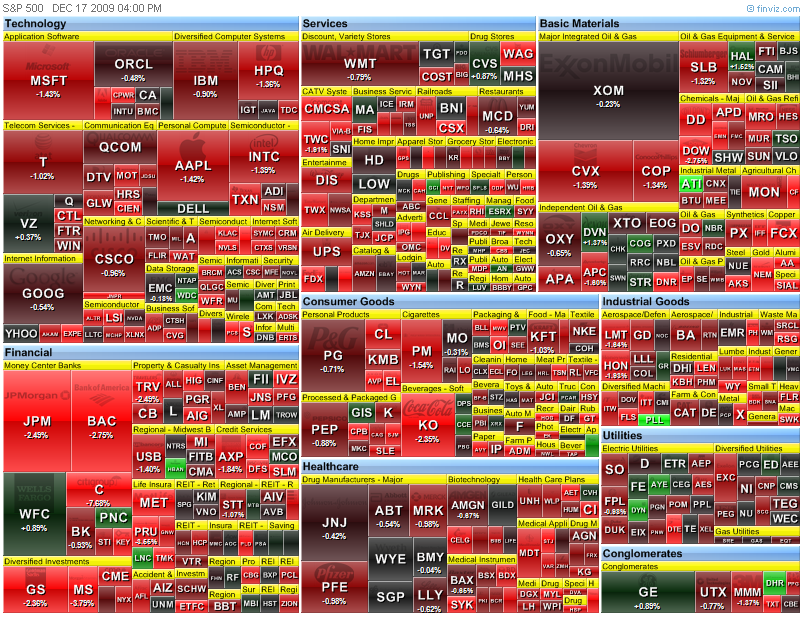
Dow 10,308 -133 -1.27%
Nasdaq 2,180 -27 -1.22%
S&P 500 1,096 -13 -1.18%
GlobalDow 1,943 -36 -1.81%
Gold 1,107 -29 -2.55%
Oil 72.61 -0.05 -0.07%


Bernanke passes Committee 16-7
From MarketWatch
Dec. 17, 2009, 11:50 a.m. EST
Senate panel approves Bernanke on 16-7 vote
Size of opposition signals rough waters ahead
By Greg Robb, MarketWatch
WASHINGTON (MarketWatch) -- The Senate Banking Committee on Thursday approved the nomination of Federal Reserve Board chairman Ben Bernanke to a second four-year term by an unusually close margin of 16-7.
The debate prior to the vote was contentious.
Several senators complained that the Fed had not provided information they requested prior to the vote. Many questioned Bernanke's actions prior to the financial crisis and during the tense days in the fall of 2008 when U.S. investment banking sector essentially disappeared overnight.
On the Economy, Stability or Growth a Tough Choice
Europe has long advocated for a stable economy; the U.S. has preferred a dynamic one. WSJ's David Wessel says those mindsets are clashing once again during the current crisis.
Analysts expect a close vote on the Senate floor after the holiday recess.
Bernanke failed to woo the support of Sen. Richard Shelby, R-Ala. and the ranking minority member of the Banking Committee.
"I strongly disapprove of some of the past deeds of the Federal Reserve while Ben Bernanke was a member and a chairman, and I lack confidence in what little plans for the future he has articulated," Shelby said in a lengthy statement.
Shelby's opposition means the Fed won't be able to count on Republican support to fend off sweeping changes to the Fed's regulatory powers put forward by Sen. Christopher Dodd, D.-Conn., and the chairman of the panel.
Dodd has said that the Fed's oversight of the biggest banks prior to the financial crisis was an "abysmal failure." Dodd has proposed stripping the oversight power from the Fed and giving it to a new single banking regulator to oversee the financial sector.
Supporters of Bernanke said that opponents were just engaging in typical Monday-morning-quarterbacking after a crisis abates.
"He's the guy I would hire" to get the U.S. out of trouble, said Sen. Judd Gregg, R.-N.H.
Filly Fed Leading Indicators - 10:00
Full report here
Released: Thursday, December 17, 2009
The Conference Board Leading Economic Index™ (LEI) for the U.S. increased 0.9 percent in November, following a 0.3 percent gain in October, and a 1.2 percent rise in September.
Download a PDF of the technical notes for underlying detail, diffusion indexes, components, contributions and graphs.
Download a PDF of the press release with graph and summary table.
Says Ataman Ozyildirim, Economist at The Conference Board: "The Conference Board LEI has been on an uptrend for more than half a year and it is now slightly higher than its latest peak in July 2007. Improving financial conditions, labor market indicators, and housing permits have helped the LEI continue its gains in November. However, its six-month growth rate has slowed somewhat in recent months."
Says Ken Goldstein, Economist at The Conference Board: "The indicators point to a bright new year. The U.S. LEI increased for the eighth consecutive month. Looking ahead, we can expect a slowly improving economy through 2010. The Conference Board Coincident Economic Index™ (CEI) for the U.S. also increased in November. Employment largely held steady, making this the first month since December 2007 that it did not make a negative contribution to the index."
The Conference Board Coincident Economic Index™ (CEI) for the U.S.rose 0.2 percent in November, following no change in October, and a 0.1 percent decline in September. The Conference Board Lagging Economic Index™ (LAG) declined 0.4 percent in November, following a 0.2 percent decline in October, and a 0.5 percent decline in September.
The next release is scheduled for January 21, 2010 at 10 A.M. ET.
Professional Contacts at The Conference Board:
Ken Goldstein: 212-339-0331
Indicators Program: 212-339-0330
Media Contacts:
Frank Tortorici: +1 212 339 0231
Email:
indicators@conference-board.org
Jobless claims - 8:30
Full report here
UNEMPLOYMENT INSURANCE WEEKLY CLAIMS REPORT
SEASONALLY ADJUSTED DATA
In the week ending Dec. 12, the advance figure for seasonally adjusted initial claims was 480,000, an increase of 7,000 from the previous week's revised figure of 473,000. The 4-week moving average was 467,500, a decrease of 5,250 from the previous week's revised average of 472,750.
The advance seasonally adjusted insured unemployment rate was 3.9 percent for the week ending Dec. 5, unchanged from the prior week's unrevised rate of 3.9 percent.
The advance number for seasonally adjusted insured unemployment during the week ending Dec. 5 was 5,186,000, an increase of 5,000 from the preceding week's revised level of 5,181,000. The 4-week moving average was 5,318,250, a decrease of 106,750 from the preceding week's revised average of 5,425,000.
The fiscal year-to-date average for seasonally adjusted insured unemployment for all programs is 5.722 million.
UNADJUSTED DATA
The advance number of actual initial claims under state programs, unadjusted, totaled 555,344 in the week ending Dec. 12, a decrease of 107,393 from the previous week. There were 629,867 initial claims in the comparable week in 2008.
The advance unadjusted insured unemployment rate was 3.9 percent during the week ending Dec. 5, a decrease of 0.2 percentage point from the prior week. The advance unadjusted number for persons claiming UI benefits in state programs totaled 5,176,122, a decrease of 222,989 from the preceding week. A year earlier, the rate was 3.3 percent and the volume was 4,378,273.
Extended benefits were available in Alabama, Alaska, Arizona, California, Colorado, Connecticut, Delaware, the District of Columbia, Florida, Georgia, Idaho, Illinois, Indiana, Kansas, Kentucky, Maine, Massachusetts, Michigan, Minnesota, Missouri, Nevada, New Hampshire, New Jersey, New Mexico, New York, North Carolina, Ohio, Oregon, Pennsylvania, Puerto Rico, Rhode Island, South Carolina, Tennessee, Texas, Vermont, Virginia, Washington, West Virginia, and Wisconsin during the week ending Nov. 28.
Initial claims for UI benefits by former Federal civilian employees totaled 2,081 in the week ending Dec. 5, an increase of 340 from the prior week. There were 2,390 initial claims by newly discharged veterans, an increase of 1,007 from the preceding week.
There were 25,903 former Federal civilian employees claiming UI benefits for the week ending Nov. 28, an increase of 1,764 from the previous week. Newly discharged veterans claiming benefits totaled 36,441, an increase of 2,689 from the prior week.
States reported 4,226,300 persons claiming EUC (Emergency Unemployment Compensation) benefits for the week ending Nov. 28, an increase of 45,922 from the prior week. There were 994,188 claimants in the comparable week in 2008. EUC weekly claims include first, second, and third tier activity.
The highest insured unemployment rates in the week ending Nov. 28 were in Wisconsin (6.4 percent), Oregon (6.3), Alaska (6.2), Nevada (5.5), Puerto Rico (5.4), Michigan (5.3), Pennsylvania (5.3), Arkansas (5.2), Idaho (5.2), North Carolina (5.2), and Washington (5.2).
The largest increases in initial claims for the week ending Dec. 5 were in California (+28,358), Georgia (+19,454), North Carolina (+18,500), Pennsylvania (+17,372), and New York (+16,344), while the largest decreases were in Kansas (-3,803), Kentucky (-2,048), Idaho (-979), Iowa (-917), and Puerto Rico (-892).
More at link with formatted tables
Pre-market - Thursday - December 17, 2009
Futures down on a stronger dollar and waiting on jobless claims report.
DJIA INDEX 10,347.00 -43.00
S&P 500 1,099.50 -6.20
NASDAQ 100 1,790.75 -9.25
Today's economic reports:
Jobless Claims 8:30 AM ET
Leading Indicators 10:00 AM ET
Philadelphia Fed Survey 10:00 AM ET
EIA Natural Gas Report 10:30 AM ET
3-Month Bill Announcement 11:00 AM ET
6-Month Bill Announcement 11:00 AM ET
Money Supply 4:30 PM ET
Today's economic reports:
Before open:
ATU Actuant Corporation Industrial Goods Diversified Machinery
BRLI Bio-Reference Laboratories Inc. Healthcare Medical Laboratories & Research
DFS Discover Financial Services Financial Credit Services
FDX FedEx Corporation Services Air Delivery & Freight Services
GIS General Mills Inc. Consumer Goods Processed & Packaged Goods
MCS The Marcus Corporation Services Lodging
MS Morgan Stanley Financial Diversified Investments
PIR Pier 1 Imports Inc. Services Home Furnishing Stores
RAD Rite Aid Corp. Services Drug Stores
SCHL Scholastic Corporation Services Publishing - Books
WGO Winnebago Industries Inc. Consumer Goods Recreational Vehicles
After close:
ACN Accenture plc Services Management Services
APSG Applied Signal Technology, Inc. Technology Communication Equipment
COMS 3Com Corporation Technology Networking & Communication Devices
CRI Carter's, Inc. Consumer Goods Textile - Apparel Clothing
DRI Darden Restaurants, Inc. Services Restaurants
HEI HEICO Corp. Industrial Goods Aerospace/Defense Products & Services
LUB Luby's Inc. Services Restaurants
NKE Nike Inc. Consumer Goods Textile - Apparel Footwear & Accessories
ORCL Oracle Corp. Technology Application Software
PALM Palm, Inc. Technology Personal Computers
RFMI RF Monolithics Inc. Technology Communication Equipment
RIMM Research In Motion Ltd. Technology Diversified Communication Services
SCS Steelcase Inc. Consumer Goods Business Equipment
SMOD SMART Modular Technologies (WWH) Inc. Technology Semiconductor - Integrated Circuits
ZQK Quiksilver Inc. Consumer Goods Textile - Apparel Clothing
Wednesday, December 16, 2009
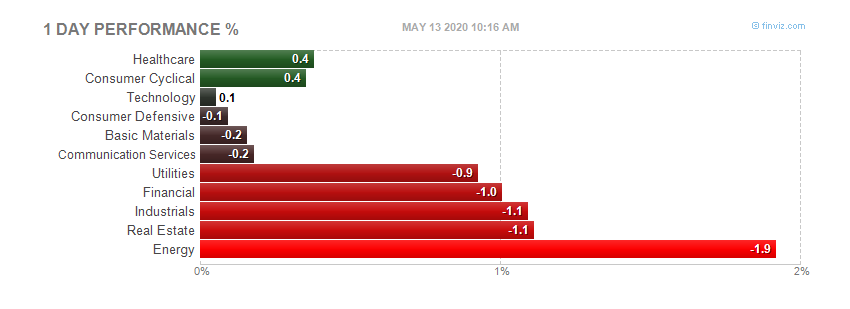
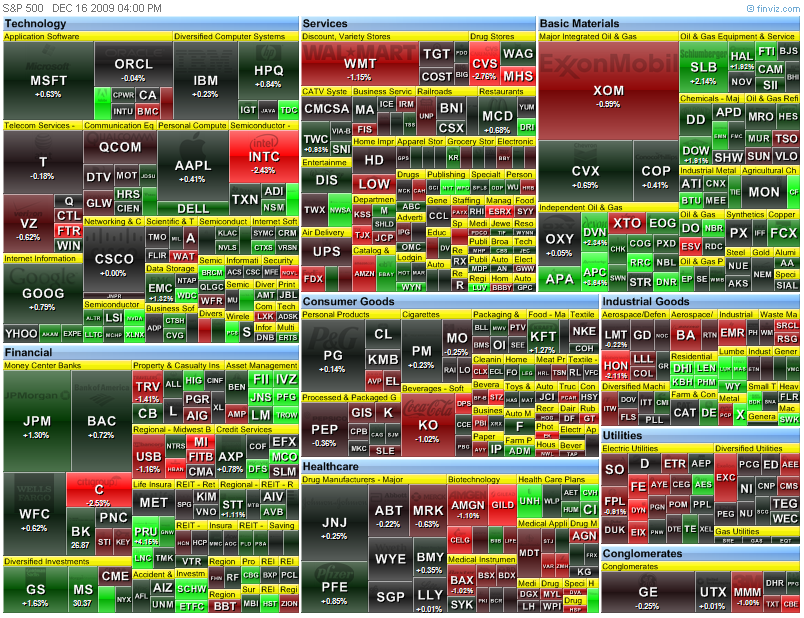
Market wrap - 4:10
Market gapped up this morning hitting 1116 early in the day. Didn't do much until the Fed statement at 2:15 and sold off a bit.
Dow 10,441 -11 -0.10%
Nasdaq 2,207 6 0.27%
S&P 500 1,109 1 0.11%
GlobalDow 1,977 +10 +0.52%
Gold 1,136 +13 +1.16%
Oil 72.67 +1.98 +2.80%


Fed Statement - 2:15
Full report here
Release Date: December 16, 2009
For immediate release
Information received since the Federal Open Market Committee met in November suggests that economic activity has continued to pick up and that the deterioration in the labor market is abating. The housing sector has shown some signs of improvement over recent months. Household spending appears to be expanding at a moderate rate, though it remains constrained by a weak labor market, modest income growth, lower housing wealth, and tight credit. Businesses are still cutting back on fixed investment, though at a slower pace, and remain reluctant to add to payrolls; they continue to make progress in bringing inventory stocks into better alignment with sales. Financial market conditions have become more supportive of economic growth. Although economic activity is likely to remain weak for a time, the Committee anticipates that policy actions to stabilize financial markets and institutions, fiscal and monetary stimulus, and market forces will contribute to a strengthening of economic growth and a gradual return to higher levels of resource utilization in a context of price stability.
With substantial resource slack likely to continue to dampen cost pressures and with longer-term inflation expectations stable, the Committee expects that inflation will remain subdued for some time.
The Committee will maintain the target range for the federal funds rate at 0 to 1/4 percent and continues to anticipate that economic conditions, including low rates of resource utilization, subdued inflation trends, and stable inflation expectations, are likely to warrant exceptionally low levels of the federal funds rate for an extended period. To provide support to mortgage lending and housing markets and to improve overall conditions in private credit markets, the Federal Reserve is in the process of purchasing $1.25 trillion of agency mortgage-backed securities and about $175 billion of agency debt. In order to promote a smooth transition in markets, the Committee is gradually slowing the pace of these purchases, and it anticipates that these transactions will be executed by the end of the first quarter of 2010. The Committee will continue to evaluate the timing and overall amounts of its purchases of securities in light of the evolving economic outlook and conditions in financial markets.
In light of ongoing improvements in the functioning of financial markets, the Committee and the Board of Governors anticipate that most of the Federal Reserve’s special liquidity facilities will expire on February 1, 2010, consistent with the Federal Reserve’s announcement of June 25, 2009. These facilities include the Asset-Backed Commercial Paper Money Market Mutual Fund Liquidity Facility, the Commercial Paper Funding Facility, the Primary Dealer Credit Facility, and the Term Securities Lending Facility. The Federal Reserve will also be working with its central bank counterparties to close its temporary liquidity swap arrangements by February 1. The Federal Reserve expects that amounts provided under the Term Auction Facility will continue to be scaled back in early 2010. The anticipated expiration dates for the Term Asset-Backed Securities Loan Facility remain set at June 30, 2010, for loans backed by new-issue commercial mortgage-backed securities and March 31, 2010, for loans backed by all other types of collateral. The Federal Reserve is prepared to modify these plans if necessary to support financial stability and economic growth.
Voting for the FOMC monetary policy action were: Ben S. Bernanke, Chairman; William C. Dudley, Vice Chairman; Elizabeth A. Duke; Charles L. Evans; Donald L. Kohn; Jeffrey M. Lacker; Dennis P. Lockhart; Daniel K. Tarullo; Kevin M. Warsh; and Janet L. Yellen.
Housing Starts - 8:30
Full report here
NEW RESIDENTIAL CONSTRUCTION IN NOVEMBER 2009
The U.S. Census Bureau and the Department of Housing and Urban Development jointly announced the following new residential construction statistics for November 2009:
BUILDING PERMITS
Privately-owned housing units authorized by building permits in November were at a seasonally adjusted annual rate of 584,000. This is 6.0 percent (±1.6%) above the revised October rate of 551,000, but is 7.3 percent (±1.8%) below the November 2008 estimate of 630,000. Single-family authorizations in November were at a rate of 473,000; this is 5.3 percent (±1.1%) above the revised October figure of 449,000. Authorizations of units in buildings with five units or more were at a rate of 86,000 in November.
HOUSING STARTS
Privately-owned housing starts in November were at a seasonally adjusted annual rate of 574,000. This is 8.9 percent (±10.2%)* above the revised October estimate of 527,000, but is 12.4 percent (±9.1%) below the November 2008 rate of 655,000.
Single-family housing starts in November were at a rate of 482,000; this is 2.1 percent (±9.2%)* above the revised October figure of 472,000. The November rate for units in buildings with five units or more was 83,000.
HOUSING COMPLETIONS
Privately-owned housing completions in November were at a seasonally adjusted annual rate of 810,000. This is 8.7 percent (±13.7%)* above the revised October estimate of 745,000, but is 25.3 percent (±10.1%) below the November 2008 rate of 1,084,000.
Single-family housing completions in November were at a rate of 524,000; this is unchanged (±11.7%)*compared with the revised October figure. The November rate for units in buildings with five units or more was 270,000.
CPI - 8:30
Full report here
Consumer Price Index - November 2009
On a seasonally adjusted basis, the Consumer Price Index for All
Urban Consumers (CPI-U) rose 0.4 percent in November, the U.S. Bureau
of Labor Statistics reported today. Over the last 12 months the index
increased 1.8 percent before seasonal adjustment, the first positive
12-month change since February 2009.
The seasonally adjusted increase in the all items index was due to a
4.1 percent increase in the energy index. The index for gasoline rose
sharply and the indexes for electricity, fuel oil, and natural gas
also increased, creating the fourth consecutive rise in the energy
index and the largest increase since August. In contrast, the index
for all items less food and energy was unchanged in November, after
ten consecutive monthly increases. Declines in shelter indexes offset
increases in the indexes for new and used motor vehicles, medical
care, airline fares, and tobacco.
The food index rose slightly in November. As in October, the food
away from home index rose modestly while the index for food at home
was unchanged. Within the latter, three grocery store food groups
posted increases while three declined.
More at link with formatted tables
Pre-market - 8:15
Futures up a little on who knows what.
DJIA INDEX 10,437.00 39.00
S&P 500 1,109.30 5.40
NASDAQ 100 1,805.50 10.50
Today's economic calendar:
MBA Purchase Applications 7:00 AM ET
Consumer Price Index 8:30 AM ET
Housing Starts 8:30 AM ET
Current Account 8:30 AM ET
EIA Petroleum Status Report 10:30 AM ET
FOMC Meeting Announcement 2:15 PM ET
Today's earnings reports.
Before open:
JOYG Joy Global, Inc. Industrial Goods Farm & Construction Machinery
After close:
ABM ABM Industries Inc. Services Business Services
APOG Apogee Enterprises Inc. Industrial Goods General Building Materials
HOV Hovnanian Enterprises Inc. Industrial Goods Residential Construction
MATK Martek Biosciences Corp. Healthcare Biotechnology
MLHR Herman Miller Inc. Consumer Goods Business Equipment
NDSN Nordson Corp. Industrial Goods Diversified Machinery
OHB Orleans Homebuilders Inc. Industrial Goods Residential Construction
PAYX Paychex Inc. Services Staffing & Outsourcing Services
Tuesday, December 15, 2009
Market wrap - 4:15
Some bad data and a market that is probably too overbought gave back a little today.
Dow 10,452 -49 -0.47%
Nasdaq 2,201 -11 -0.49%
S&P 500 1,108 -6 -0.56%
GlobalDow 1,966 -12 -0.59%
Gold 1,123 -1 -0.10%
Oil 70.71 +1.20 +1.73%


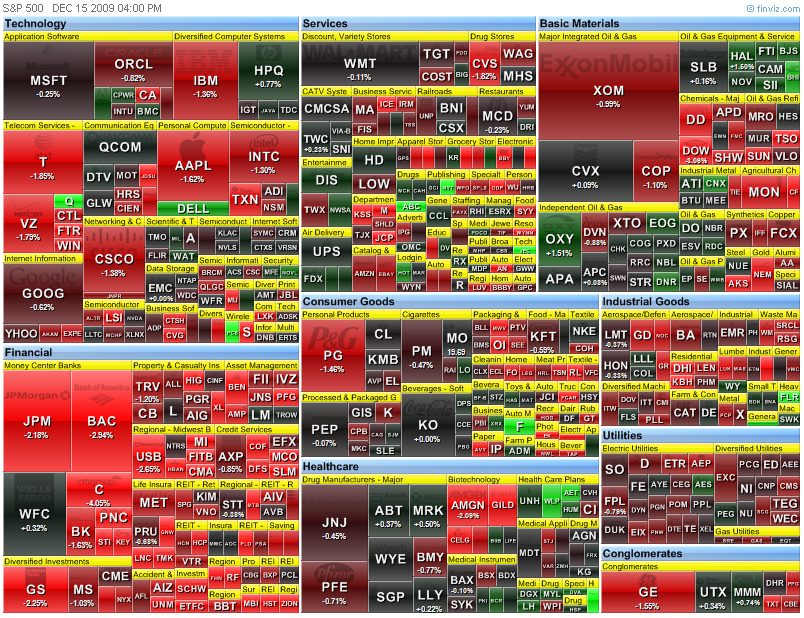
Jim Chanos and Melissa Lee - CNBC - funny interview IMHO - 2:10
As hard as Melissa Lee tries to get Jim Chanos to give a buy, buy, buy on anything, he won't. I get a kick out of her pumping bank stocks, he disagrees, but she pumps them anyway. Get this woman off TV.
More from Dylan Ratigan on the banks and lending - 1:45
Visit msnbc.com for breaking news, world news, and news about the economy

Dylan Ratigan on the banks - 1:30
Visit msnbc.com for breaking news, world news, and news about the economy
Housing market index report - 1:00
Full report here
Builder Confidence Edges Down in December
December 15, 2009 - Builder confidence in the market for newly built, single-family homes receded one point to 16 in December as continued weakness in the economy and job markets weighed on consumers’ potential home buying plans, according to the latest NAHB/Wells Fargo Housing Market Index (HMI), released today.
“From an affordability standpoint, rarely has there been a better time in history to purchase a home, thanks to record low interest rates, attractive prices, and of course the recent extension and expansion of the home buyer tax credit,” said Joe Robson, Chairman of the National Association of Home Builders (NAHB) and a home builder from Tulsa, Okla. “However, builders are not seeing the full impact of these conditions on buyer demand, partly because awareness of the latest incentives is still building, and partly because of concerns about job security and other economic woes.”
“As we anticipated, this is shaping up to be a bumpy recovery period for the housing market,” noted NAHB Chief Economist David Crowe. “While some families may be just starting to factor the expanded tax credit into their potential home buying plans, many are hesitating because of the poor economy. At the same time, tight lending conditions for both consumers and home builders continue to pose considerable obstacles on the road to a sustained housing and economic recovery.”
Derived from a monthly survey that NAHB has been conducting for more than 20 years, the NAHB/Wells Fargo Housing Market Index gauges builder perceptions of current single-family home sales and sales expectations for the next six months as “good,” “fair” or “poor.” The survey also asks builders to rate traffic of prospective buyers as “high to very high,” “average” or “low to very low.” Scores for each component are then used to calculate a seasonally adjusted index where any number over 50 indicates that more builders view sales conditions as good than poor.
The December HMI fell one point to 16, its lowest point since June of this year. Two out of three component indexes also were down, with a one-point decline to 16 registered for current sales conditions and a two-point decline to 26 registered for sales expectations in the next six months. The component gauging traffic of prospective buyers remained unchanged for a third consecutive month, at 13.
Regionally, December’s HMI results were somewhat mixed. The Northeast posted a three point gain to 23, while the West posted a one-point gain to 19, the South registered no change at 17, and the Midwest posted a two-point decline, to 12.
Editor’s Note: The NAHB/Wells Fargo Housing Market Index is strictly the product of NAHB Economics, and is not seen or influenced by any outside party prior to being released to the public. HMI tables can be accessed online at: www.nahb.org/hmi. More information on housing statistics is also available at: www.housingeconomics.com.
Industrial Production - 9:15
Full report here
INDUSTRIAL PRODUCTION AND CAPACITY UTILIZATION
Industrial production increased 0.8 percent in November after having been unchanged in October. Manufacturing production advanced 1.1 percent, with broad-based gains among both durables and nondurables. The output of mines climbed 2.1 percent, but the index for utilities fell 1.8 percent, primarily as a result of lower output of gas utilities--temperatures in November were unseasonably mild and reduced the need for heating. At 99.4 percent of its 2002 average, total industrial production was 5.1 percent below its level of a year earlier. Capacity utilization for total industry moved up 0.7 percentage point to 71.3 percent, a rate 9.6 percentage points below its average for the period from 1972 through 2008.
See link for formatted tables
Empire State Manufacturing Survey - 8:30
 Full report here
The Empire State Manufacturing Survey indicates that conditions for New York manufacturers leveled off in December, following four months of improvement. The general business conditions index fell 21 points, to 2.6. The indexes for new orders and shipments posted somewhat more moderate declines but also moved close to zero. Input prices picked up a bit, as the prices paid index rebounded to roughly its November level; however, the prices received index moved further into negative territory, suggesting that price increases are not being passed along. Current employment indexes slipped back into negative territory. Future indexes remained well above zero but signaled somewhat less widespread optimism than in recent months. Indexes for expected prices paid and received declined moderately but remained well above zero.
In a series of supplementary questions (see Supplemental Reports tab), manufacturers were asked about recent and expected changes in the prices paid for various categories of goods and services. Respondents predicted that prices paid for most budget categories would increase by 2 to 3 percentage points more in 2010 than in 2009. Prices paid overall were reported to have risen by 2.5 percent in 2009 and were expected to rise by 4.2 percent next year. The average respondent anticipated an increase of 2.1 percent in both wages and costs of outside services, 7.6 percent in employee benefit costs, and 3.5 percent in nonmedical insurance costs. In response to a separate question, the average respondent saw a roughly 7 percent chance that prices paid would decline by more than 2 percent; in last year’s survey, the probability of such a decline was pegged at 19 percent.
Conditions Level Off
The general business conditions index fell from 23.5 to just 2.6, suggesting a leveling off in conditions after four straight months of improvement. Roughly 24 percent of those surveyed in December said that conditions had improved, while 22 percent reported that conditions had deteriorated. Most of the other specific activity measures fell a bit less sharply: the new orders index slipped more than 14 points to 2.2, and the shipments measure declined by just under 7 points to 6.3. The unfilled orders index fell by more than 18 points to -21.1, its lowest level in nine months. In contrast, the index for delivery times held steady at -2.6, and the inventories index, at -18.4, was little changed for the third straight month.
Manufacturers See Margins Squeezed Survey respondents faced somewhat higher input prices in December, while their selling prices declined. The prices paid index rose 9 points to 19.7, reversing a drop of similar magnitude in November and suggesting some renewed price pressures. At the same time, the prices received index slipped 6.6 points to -9.2, its lowest level since August. Employment indexes declined for the second straight month, falling below zero for the first time in a few months: the index for number of employees slipped 7 points to -5.3, and the average workweek index fell 11 points to -5.3.
Manufacturers’ Optimism Ebbs Slightly; Prices Are Expected to Rise
Manufacturers remained generally optimistic about the outlook for general business conditions and activity, although a bit less so than in recent months. After rising to its highest level in more than a year, the index for expected general business conditions retreated 14 points to 43.0—still a high level but the lowest since July. The forward-looking indexes for both new orders and shipments fell by almost as much but remained in the upper 30s, while the future unfilled orders index declined by a more moderate 5 points to 12.0. The index for expected delivery times edged up to zero, its highest level in more than a year, and the measure for future inventories was unchanged at 7.9.
Forward-looking price indexes declined in December, after rising sharply in the preceding month: the index for future prices paid slipped nearly 8 points to 40.8, and the index for future prices received dropped about 5 points to 22.4. The index for expected number of employees reversed course in December, retreating 13 points to 17.8, while the future average workweek index was little changed at 19.7. The measure for planned capital expenditures jumped more than 9 points to 30.3, its highest level since May 2007; however, the measure for planned technology spending edged down to 13.2.
Full report here
The Empire State Manufacturing Survey indicates that conditions for New York manufacturers leveled off in December, following four months of improvement. The general business conditions index fell 21 points, to 2.6. The indexes for new orders and shipments posted somewhat more moderate declines but also moved close to zero. Input prices picked up a bit, as the prices paid index rebounded to roughly its November level; however, the prices received index moved further into negative territory, suggesting that price increases are not being passed along. Current employment indexes slipped back into negative territory. Future indexes remained well above zero but signaled somewhat less widespread optimism than in recent months. Indexes for expected prices paid and received declined moderately but remained well above zero.
In a series of supplementary questions (see Supplemental Reports tab), manufacturers were asked about recent and expected changes in the prices paid for various categories of goods and services. Respondents predicted that prices paid for most budget categories would increase by 2 to 3 percentage points more in 2010 than in 2009. Prices paid overall were reported to have risen by 2.5 percent in 2009 and were expected to rise by 4.2 percent next year. The average respondent anticipated an increase of 2.1 percent in both wages and costs of outside services, 7.6 percent in employee benefit costs, and 3.5 percent in nonmedical insurance costs. In response to a separate question, the average respondent saw a roughly 7 percent chance that prices paid would decline by more than 2 percent; in last year’s survey, the probability of such a decline was pegged at 19 percent.
Conditions Level Off
The general business conditions index fell from 23.5 to just 2.6, suggesting a leveling off in conditions after four straight months of improvement. Roughly 24 percent of those surveyed in December said that conditions had improved, while 22 percent reported that conditions had deteriorated. Most of the other specific activity measures fell a bit less sharply: the new orders index slipped more than 14 points to 2.2, and the shipments measure declined by just under 7 points to 6.3. The unfilled orders index fell by more than 18 points to -21.1, its lowest level in nine months. In contrast, the index for delivery times held steady at -2.6, and the inventories index, at -18.4, was little changed for the third straight month.
Manufacturers See Margins Squeezed Survey respondents faced somewhat higher input prices in December, while their selling prices declined. The prices paid index rose 9 points to 19.7, reversing a drop of similar magnitude in November and suggesting some renewed price pressures. At the same time, the prices received index slipped 6.6 points to -9.2, its lowest level since August. Employment indexes declined for the second straight month, falling below zero for the first time in a few months: the index for number of employees slipped 7 points to -5.3, and the average workweek index fell 11 points to -5.3.
Manufacturers’ Optimism Ebbs Slightly; Prices Are Expected to Rise
Manufacturers remained generally optimistic about the outlook for general business conditions and activity, although a bit less so than in recent months. After rising to its highest level in more than a year, the index for expected general business conditions retreated 14 points to 43.0—still a high level but the lowest since July. The forward-looking indexes for both new orders and shipments fell by almost as much but remained in the upper 30s, while the future unfilled orders index declined by a more moderate 5 points to 12.0. The index for expected delivery times edged up to zero, its highest level in more than a year, and the measure for future inventories was unchanged at 7.9.
Forward-looking price indexes declined in December, after rising sharply in the preceding month: the index for future prices paid slipped nearly 8 points to 40.8, and the index for future prices received dropped about 5 points to 22.4. The index for expected number of employees reversed course in December, retreating 13 points to 17.8, while the future average workweek index was little changed at 19.7. The measure for planned capital expenditures jumped more than 9 points to 30.3, its highest level since May 2007; however, the measure for planned technology spending edged down to 13.2.
PPI - 8:30
Full report here
PRODUCER PRICE INDEXES - NOVEMBER 2009
The Producer Price Index for Finished Goods rose 1.8 percent in November, seasonally adjusted, the U.S. Bureau of Labor Statistics reported today. This increase followed a 0.3-percent advance in October and a 0.6-percent decrease in September. In November, at the earlier stages of processing, prices received by manufacturers of intermediate goods climbed 1.4 percent, and the crude goods index rose 5.7 percent. On an unadjusted basis, prices for finished goods moved up 2.4 percent for the 12 months ended November 2009, their first 12-month increase since November 2008. (See table A.)
SEE TABLE A AT LINK
Stage-of-Processing Analysis
Finished goods
About three-fourths of the November advance in the finished goods index can be traced to higher prices for energy goods, which jumped 6.9 percent. The indexes for finished goods less foods and energy and for finished consumer foods also contributed to the finished goods increase, both rising 0.5 percent.
Finished energy: The index for finished energy goods climbed 6.9 percent in November after advancing 1.6 percent a month earlier. About sixty percent of the broad-based November rise can be attributed to a 14.2-percent surge in gasoline prices. Increases in the indexes for liquefied petroleum gas and home heating oil also were major factors in the finished energy goods
advance. (See table 2.)
Finished core: The index for finished goods less foods and energy moved up 0.5 percent in November, its largest increase since a 0.5-percent gain in October 2008. Leading the November advance, the index for light motor trucks jumped 4.2 percent. Higher cigarette prices also contributed to the rise in the finished core index.
Finished foods: The index for finished consumer foods advanced 0.5 percent in November, its second consecutive monthly increase. Over sixty percent of the November rise can be traced to higher prices for fresh and dry vegetables, which climbed 8.7 percent.
Intermediate goods
The Producer Price Index for Intermediate Materials, Supplies, and Components rose 1.4 percent in November, its fourth straight monthly advance. Accounting for about three-fourths of the broad-based November increase, prices for intermediate energy goods climbed 5.4 percent. The indexes for both intermediate goods less foods and energy and for intermediate foods and feeds also contributed to this advance, rising 0.3 and 0.7 percent, respectively. On a 12-month basis, prices for intermediate goods fell 1.6 percent in November. This is the fourth consecutive month of slowing year-over-year declines following a record 15.2-percent drop for the 12 months ended
July 2009. (See table B.)
Intermediate energy: The index for intermediate energy goods rose 5.4 percent in November, its second consecutive monthly increase. A major factor in the November advance was an 18.8-percent surge in jet fuel prices. The indexes for gasoline and liquefied petroleum gas also contributed significantly to higher intermediate energy goods prices. (See table 2).
Intermediate core: Prices for intermediate materials less foods and energy increased 0.3 percent in November, their fifth increase in the last six months. The index for basic organic chemicals led the November advance, rising 4.3 percent. Higher prices for medicinal and botanical chemicals also were a factor in the intermediate core increase.
Intermediate foods: The index for intermediate foods and feeds moved up 0.7 percent in November following two consecutive monthly declines. About forty percent of this advance can be attributed to prices for pork, which climbed 6.4 percent.
Crude goods
The Producer Price Index for Crude Materials for Further Processing increased 5.7 percent in November. For the 3-month period ending in November, crude material prices rose 9.1 percent after advancing 4.4 percent in the 3 months ending in August. In November, monthly increases of 12.2 percent in the index for crude energy materials and 2.6 percent for prices of crude foodstuffs and feedstuffs outweighed a 0.8-percent decrease in the index for crude nonfood materials less energy. (See table B.)
Crude energy: The index for crude energy materials increased 12.2 percent in November. From August to November, this index rose 15.0 percent compared with a 12.6-percent rise in the 3 months ending in August. Accounting for about two-thirds of the monthly November increase, the index for natural gas jumped 25.5 percent. Higher prices for both crude petroleum and coal also contributed to the advance in the crude energy materials index. (See table 2.)
Crude foods: Prices for crude foodstuffs and feedstuffs rose 2.6 percent in November. This index moved up 5.8 percent in the most recent 3-month period compared with a 7.1-percent decline in the previous 3-month period. In November, over sixty percent of the monthly increase in the crude foods index can be attributed to a 25.6-percent surge in prices for slaughter hogs. An advance in the fluid milk index also was a significant factor in the rise for crude foodstuffs and
feedstuffs.
SEE TABLE B AT LINK
Services Analysis
Trade industries: The Producer Price Index for the Net Output of Total Trade Industries moved up 1.3 percent in November after no change in the previous month. (Trade indexes measure changes in margins received by wholesalers and retailers.) The November increase was led by a 36.5-percent rise in the margin index for gasoline stations. Higher margins received by merchant wholesalers of durable goods and general merchandise stores also contributed to the advance in the total trade industries index.
Transportation and warehousing industries: The Producer Price Index for the Net Output of Total Transportation and Warehousing Industries rose 0.5 percent in November, its second consecutive monthly increase. About seventy percent of the November advance can be traced to a 1.8-percent rise in prices received by the air transportation industry group. The indexes for long-distance general freight trucking (by the truckload) and specialized freight trucking also moved
up in November.
Traditional service industries: The Producer Price Index for the Net Output of Total Traditional Service Industries declined 0.1 percent in November after advancing 0.5 percent in October. Two-thirds of this decline can be attributed to prices received by general and medical surgical hospitals, which fell 0.5 percent. The industry indexes for non-casino hotels and motels and for passenger car rental also decreased in November.
See link for formatted tables
Pre-market - 7:50
Futures down slightly on a stronger dollar index.
DJIA INDEX 10,410.00 -27.00
S&P 500 1,105.30 -3.30
NASDAQ 100 1,802.50 -5.25
Today's economic calendar:
FOMC Meeting Begins
ICSC-Goldman Store Sales 7:45 AM ET
Producer Price Index 8:30 AM ET
Empire State Mfg Survey 8:30 AM ET
Redbook 8:55 AM ET
Treasury International Capital 9:00 AM ET
Industrial Production 9:15 AM ET
4-Week Bill Auction 11:30 AM ET
52-Week Bill Auction 11:30 AM ET
Housing Market Index 1:00 PM ET
Today's earnings reports
Before open:
AEY ADDvantage Technologies Group Inc. Services Electronics Wholesale
BBY Best Buy Co. Inc. Services Electronics Stores
FDS FactSet Research Systems Inc. Technology Information & Delivery Services
GIGM GigaMedia Ltd. Technology Internet Software & Services
GS Goldman Sachs Group Inc. Financial Diversified Investments
After close:
ADBE Adobe Systems Inc. Technology Application Software
AIR AAR Corp. Industrial Goods Aerospace/Defense Products & Services
CLC CLARCOR Inc. Consumer Goods Auto Parts
HRAY Hurray! Holding Co. Ltd. Technology Business Software & Services
SURG Synergetics USA, Inc. Healthcare Medical Appliances & Equipment
WPCS WPCS International Incorporated Technology Diversified Communication Services
Monday, December 14, 2009
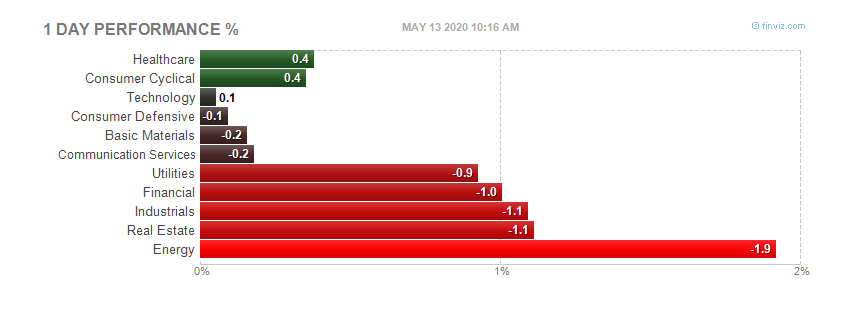
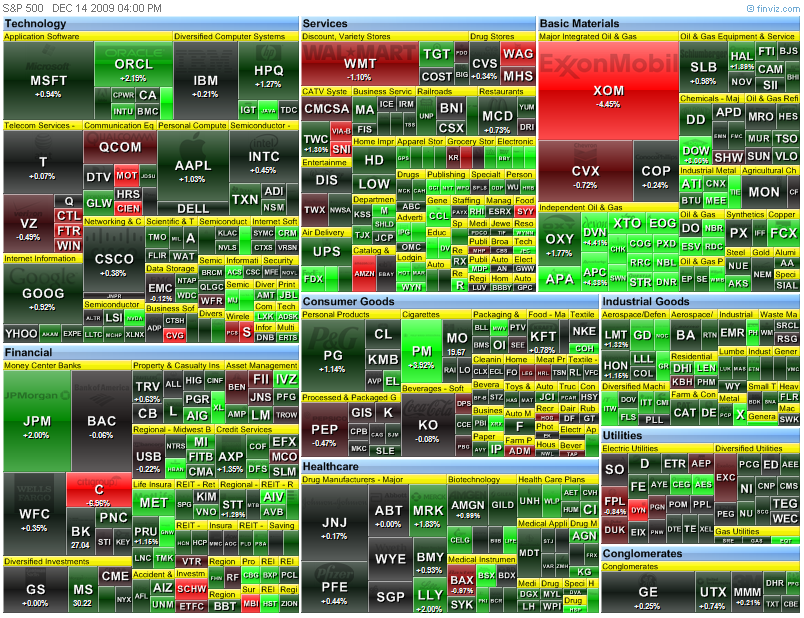
Market wrap - 4:15
Just another day of pumping junk stocks to make the indexes go up.
Dow 10,501 30 0.28%
Nasdaq 2,212 22 0.99%
S&P 500 1,114 8 0.70%
GlobalDow 1,978 +14 +0.74%
Gold 1,124 +4 +0.35%
Oil 69.68 -0.19 -0.27%


Pre-market - December 14, 2009
Futures up on the news Abu Dhabi will bail out Dubai.
DJIA INDEX 10,461.00 38.00
S&P 500 1,107.50 4.30
NASDAQ 100 1,799.50 7.50
Today's economic calendar:
4-Week Bill Announcement 11:00 AM ET
3-Month Bill Auction 11:30 AM ET
6-Month Bill Auction 11:30 AM ET
Today's earnings reports:
Before open:
NTSC National Technical Systems Inc. Services Research Services
After close:
ALCO Alico Inc. Consumer Goods Farm Products
ANGN Angeion Corp. Healthcare Medical Instruments & Supplies
BRT BRT Realty Trust Financial Mortgage Investment
IAAC International Assets Holding Corporation Financial Asset Management
IESC Integrated Electrical Services, Inc. Industrial Goods General Contractors
PAY VeriFone Holdings, Inc. Consumer Goods Business Equipment
SEH Spartech Corp. Consumer Goods Rubber & Plastics
SNS Steak n Shake Co. Services Restaurants
Friday, December 11, 2009
Market wrap - 4:15
Another boorrrriiinnnggg day in the market. Really didn't do much. DOW up nicely but the other indexes were flat. Ho friken hum.
Dow 10,472 66 0.63%
Nasdaq 2,190 -1 -0.03%
S&P 500 1,106 4 0.37%
Gold 1,120 -7 -0.59%
Oil 69.79 -0.67 -0.95%


Rolling Stone article from Matt Taibbi - Wow!
Link to Rolling Stone article here.
Obama's Big Sellout
The president has packed his economic team with Wall Street insiders intent on turning the bailout into an all-out giveaway
MATT TAIBBI
Posted Dec 09, 2009 2:35 PM
Barack Obama ran for president as a man of the people, standing up to Wall Street as the global economy melted down in that fateful fall of 2008. He pushed a tax plan to soak the rich, ripped NAFTA for hurting the middle class and tore into John McCain for supporting a bankruptcy bill that sided with wealthy bankers "at the expense of hardworking Americans." Obama may not have run to the left of Samuel Gompers or Cesar Chavez, but it's not like you saw him on the campaign trail flanked by bankers from Citigroup and Goldman Sachs. What inspired supporters who pushed him to his historic win was the sense that a genuine outsider was finally breaking into an exclusive club, that walls were being torn down, that things were, for lack of a better or more specific term, changing.
Then he got elected.
What's taken place in the year since Obama won the presidency has turned out to be one of the most dramatic political about-faces in our history. Elected in the midst of a crushing economic crisis brought on by a decade of orgiastic deregulation and unchecked greed, Obama had a clear mandate to rein in Wall Street and remake the entire structure of the American economy. What he did instead was ship even his most marginally progressive campaign advisers off to various bureaucratic Siberias, while packing the key economic positions in his White House with the very people who caused the crisis in the first place. This new team of bubble-fattened ex-bankers and laissez-faire intellectuals then proceeded to sell us all out, instituting a massive, trickle-up bailout and systematically gutting regulatory reform from the inside.
How could Obama let this happen? Is he just a rookie in the political big leagues, hoodwinked by Beltway old-timers? Or is the vacillating, ineffectual servant of banking interests we've been seeing on TV this fall who Obama really is?
Whatever the president's real motives are, the extensive series of loophole-rich financial "reforms" that the Democrats are currently pushing may ultimately do more harm than good. In fact, some parts of the new reforms border on insanity, threatening to vastly amplify Wall Street's political power by institutionalizing the taxpayer's role as a welfare provider for the financial-services industry. At one point in the debate, Obama's top economic advisers demanded the power to award future bailouts without even going to Congress for approval — and without providing taxpayers a single dime in equity on the deals.
How did we get here? It started just moments after the election — and almost nobody noticed.
'Just look at the timeline of the Citigroup deal," says one leading Democratic consultant. "Just look at it. It's fucking amazing. Amazing! And nobody said a thing about it."
Barack Obama was still just the president-elect when it happened, but the revolting and inexcusable $306 billion bailout that Citigroup received was the first major act of his presidency. In order to grasp the full horror of what took place, however, one needs to go back a few weeks before the actual bailout — to November 5th, 2008, the day after Obama's election.
That was the day the jubilant Obama campaign announced its transition team. Though many of the names were familiar — former Bill Clinton chief of staff John Podesta, long-time Obama confidante Valerie Jarrett — the list was most notable for who was not on it, especially on the economic side. Austan Goolsbee, a University of Chicago economist who had served as one of Obama's chief advisers during the campaign, didn't make the cut. Neither did Karen Kornbluh, who had served as Obama's policy director and was instrumental in crafting the Democratic Party's platform. Both had emphasized populist themes during the campaign: Kornbluh was known for pushing Democrats to focus on the plight of the poor and middle class, while Goolsbee was an aggressive critic of Wall Street, declaring that AIG executives should receive "a Nobel Prize — for evil."
But come November 5th, both were banished from Obama's inner circle — and replaced with a group of Wall Street bankers. Leading the search for the president's new economic team was his close friend and Harvard Law classmate Michael Froman, a high-ranking executive at Citigroup. During the campaign, Froman had emerged as one of Obama's biggest fundraisers, bundling $200,000 in contributions and introducing the candidate to a host of heavy hitters — chief among them his mentor Bob Rubin, the former co-chairman of Goldman Sachs who served as Treasury secretary under Bill Clinton. Froman had served as chief of staff to Rubin at Treasury, and had followed his boss when Rubin left the Clinton administration to serve as a senior counselor to Citigroup (a massive new financial conglomerate created by deregulatory moves pushed through by Rubin himself).
Incredibly, Froman did not resign from the bank when he went to work for Obama: He remained in the employ of Citigroup for two more months, even as he helped appoint the very people who would shape the future of his own firm. And to help him pick Obama's economic team, Froman brought in none other than Jamie Rubin, a former Clinton diplomat who happens to be Bob Rubin's son. At the time, Jamie's dad was still earning roughly $15 million a year working for Citigroup, which was in the midst of a collapse brought on in part because Rubin had pushed the bank to invest heavily in mortgage-backed CDOs and other risky instruments.
Now here's where it gets really interesting. It's three weeks after the election. You have a lame-duck president in George W. Bush — still nominally in charge, but in reality already halfway to the golf-and-O'Doul's portion of his career and more than happy to vacate the scene. Left to deal with the still-reeling economy are lame-duck Treasury Secretary Henry Paulson, a former head of Goldman Sachs, and New York Fed chief Timothy Geithner, who served under Bob Rubin in the Clinton White House. Running Obama's economic team are a still-employed Citigroup executive and the son of another Citigroup executive, who himself joined Obama's transition team that same month.
So on November 23rd, 2008, a deal is announced in which the government will bail out Rubin's messes at Citigroup with a massive buffet of taxpayer-funded cash and guarantees. It is a terrible deal for the government, almost universally panned by all serious economists, an outrage to anyone who pays taxes. Under the deal, the bank gets $20 billion in cash, on top of the $25 billion it had already received just weeks before as part of the Troubled Asset Relief Program. But that's just the appetizer. The government also agrees to charge taxpayers for up to $277 billion in losses on troubled Citi assets, many of them those toxic CDOs that Rubin had pushed Citi to invest in. No Citi executives are replaced, and few restrictions are placed on their compensation. It's the sweetheart deal of the century, putting generations of working-stiff taxpayers on the hook to pay off Bob Rubin's fuck-up-rich tenure at Citi. "If you had any doubts at all about the primacy of Wall Street over Main Street," former labor secretary Robert Reich declares when the bailout is announced, "your doubts should be laid to rest."
It is bad enough that one of Bob Rubin's former protégés from the Clinton years, the New York Fed chief Geithner, is intimately involved in the negotiations, which unsurprisingly leave the Federal Reserve massively exposed to future Citi losses. But the real stunner comes only hours after the bailout deal is struck, when the Obama transition team makes a cheerful announcement: Timothy Geithner is going to be Barack Obama's Treasury secretary!
Geithner, in other words, is hired to head the U.S. Treasury by an executive from Citigroup — Michael Froman — before the ink is even dry on a massive government giveaway to Citigroup that Geithner himself was instrumental in delivering. In the annals of brazen political swindles, this one has to go in the all-time Fuck-the-Optics Hall of Fame.
Wall Street loved the Citi bailout and the Geithner nomination so much that the Dow immediately posted its biggest two-day jump since 1987, rising 11.8 percent. Citi shares jumped 58 percent in a single day, and JP Morgan Chase, Merrill Lynch and Morgan Stanley soared more than 20 percent, as Wall Street embraced the news that the government's bailout generosity would not die with George W. Bush and Hank Paulson. "Geithner assures a smooth transition between the Bush administration and that of Obama, because he's already co-managing what's happening now," observed Stephen Leeb, president of Leeb Capital Management.
Left unnoticed, however, was the fact that Geithner had been hired by a sitting Citigroup executive who still had a big bonus coming despite his proximity to Obama. In January 2009, just over a month after the bailout, Citigroup paid Froman a year-end bonus of $2.25 million. But as outrageous as it was, that payoff would prove to be chump change for the banker crowd, who were about to get everything they wanted — and more — from the new president.
The irony of Bob Rubin: He's an unapologetic arch-capitalist demagogue whose very career is proof that a free-market meritocracy is a myth. Much like Alan Greenspan, a staggeringly incompetent economic forecaster who was worshipped by four decades of politicians because he once dated Barbara Walters, Rubin has been held in awe by the American political elite for nearly 20 years despite having fucked up virtually every project he ever got his hands on. He went from running Goldman Sachs (1990-1992) to the Clinton White House (1993-1999) to Citigroup (1999-2009), leaving behind a trail of historic gaffes that somehow boosted his stature every step of the way.
As Treasury secretary under Clinton, Rubin was the driving force behind two monstrous deregulatory actions that would be primary causes of last year's financial crisis: the repeal of the Glass-Steagall Act (passed specifically to legalize the Citigroup megamerger) and the deregulation of the derivatives market. Having set that time bomb, Rubin left government to join Citi, which promptly expressed its gratitude by giving him $126 million in compensation over the next eight years (they don't call it bribery in this country when they give you the money post factum). After urging management to amp up its risky investments in toxic vehicles, a strategy that very nearly destroyed the company, Rubin blamed Citi's board for his screw-ups and complained that he had been underpaid to boot. "I bet there's not a single year where I couldn't have gone somewhere else and made more," he said.
Despite being perhaps more responsible for last year's crash than any other single living person — his colossally stupid decisions at both the highest levels of government and the management of a private financial superpower make him unique — Rubin was the man Barack Obama chose to build his White House around.
There are four main ways to be connected to Bob Rubin: through Goldman Sachs, the Clinton administration, Citigroup and, finally, the Hamilton Project, a think tank Rubin spearheaded under the auspices of the Brookings Institute to promote his philosophy of balanced budgets, free trade and financial deregulation. The team Obama put in place to run his economic policy after his inauguration was dominated by people who boasted connections to at least one of these four institutions — so much so that the White House now looks like a backstage party for an episode of Bob Rubin, This Is Your Life!
At Treasury, there is Geithner, who worked under Rubin in the Clinton years. Serving as Geithner's "counselor" — a made-up post not subject to Senate confirmation — is Lewis Alexander, the former chief economist of Citigroup, who advised Citi back in 2007 that the upcoming housing crash was nothing to worry about. Two other top Geithner "counselors" — Gene Sperling and Lael Brainard — worked under Rubin at the National Economic Council, the key group that coordinates all economic policymaking for the White House.
As director of the NEC, meanwhile, Obama installed economic czar Larry Summers, who had served as Rubin's protégé at Treasury. Just below Summers is Jason Furman, who worked for Rubin in the Clinton White House and was one of the first directors of Rubin's Hamilton Project. The appointment of Furman — a persistent advocate of free-trade agreements like NAFTA and the author of droolingly pro-globalization reports with titles like "Walmart: A Progressive Success Story" — provided one of the first clues that Obama had only been posturing when he promised crowds of struggling Midwesterners during the campaign that he would renegotiate NAFTA, which facilitated the flight of blue-collar jobs to other countries. "NAFTA's shortcomings were evident when signed, and we must now amend the agreement to fix them," Obama declared. A few months after hiring Furman to help shape its economic policy, however, the White House quietly quashed any talk of renegotiating the trade deal. "The president has said we will look at all of our options, but I think they can be addressed without having to reopen the agreement," U.S. Trade Representative Ronald Kirk told reporters in a little-publicized conference call last April.
The announcement was not so surprising, given who Obama hired to serve alongside Furman at the NEC: management consultant Diana Farrell, who worked under Rubin at Goldman Sachs. In 2003, Farrell was the author of an infamous paper in which she argued that sending American jobs overseas might be "as beneficial to the U.S. as to the destination country, probably more so."
Joining Summers, Furman and Farrell at the NEC is Froman, who by then had been formally appointed to a unique position: He is not only Obama's international finance adviser at the National Economic Council, he simultaneously serves as deputy national security adviser at the National Security Council. The twin posts give Froman a direct line to the president, putting him in a position to coordinate Obama's international economic policy during a crisis. He'll have help from David Lipton, another joint appointee to the economics and security councils who worked with Rubin at Treasury and Citigroup, and from Jacob Lew, a former Citi colleague of Rubin's whom Obama named as deputy director at the State Department to focus on international finance.
Over at the Commodity Futures Trading Commission, which is supposed to regulate derivatives trading, Obama appointed Gary Gensler, a former Goldman banker who worked under Rubin in the Clinton White House. Gensler had been instrumental in helping to pass the infamous Commodity Futures Modernization Act of 2000, which prevented deregulation of derivative instruments like CDOs and credit-default swaps that played such a big role in cratering the economy last year. And as head of the powerful Office of Management and Budget, Obama named Peter Orszag, who served as the first director of Rubin's Hamilton Project. Orszag once succinctly summed up the project's ideology as a sort of liberal spin on trickle-down Reaganomics: "Market competition and globalization generate significant economic benefits."
Taken together, the rash of appointments with ties to Bob Rubin may well represent the most sweeping influence by a single Wall Street insider in the history of government. "Rather than having a team of rivals, they've got a team of Rubins," says Steven Clemons, director of the American Strategy Program at the New America Foundation. "You see that in policy choices that have resuscitated — but not reformed — Wall Street."
While Rubin's allies and acolytes got all the important jobs in the Obama administration, the academics and progressives got banished to semi-meaningless, even comical roles. Kornbluh was rewarded for being the chief policy architect of Obama's meteoric rise by being outfitted with a pith helmet and booted across the ocean to Paris, where she now serves as America's never-again-to-be-seen-on-TV ambassador to the Organization for Economic Cooperation and Development. Goolsbee, meanwhile, was appointed as staff director of the President's Economic Recovery Advisory Board, a kind of dumping ground for Wall Street critics who had assisted Obama during the campaign; one top Democrat calls the panel "Siberia."
Joining Goolsbee as chairman of the PERAB gulag is former Fed chief Paul Volcker, who back in March 2008 helped candidate Obama write a speech declaring that the deregulatory efforts of the Eighties and Nineties had "excused and even embraced an ethic of greed, corner-cutting, insider dealing, things that have always threatened the long-term stability of our economic system." That speech met with rapturous applause, but the commission Obama gave Volcker to manage is so toothless that it didn't even meet for the first time until last May. The lone progressive in the White House, economist Jared Bernstein, holds the impressive-sounding title of chief economist and national policy adviser — except that the man he is advising is Joe Biden, who seems more interested in foreign policy than financial reform.
The significance of all of these appointments isn't that the Wall Street types are now in a position to provide direct favors to their former employers. It's that, with one or two exceptions, they collectively offer a microcosm of what the Democratic Party has come to stand for in the 21st century. Virtually all of the Rubinites brought in to manage the economy under Obama share the same fundamental political philosophy carefully articulated for years by the Hamilton Project: Expand the safety net to protect the poor, but let Wall Street do whatever it wants. "Bob Rubin, these guys, they're classic limousine liberals," says David Sirota, a former Democratic strategist. "These are basically people who have made shitloads of money in the speculative economy, but they want to call themselves good Democrats because they're willing to give a little more to the poor. That's the model for this Democratic Party: Let the rich do their thing, but give a fraction more to everyone else."
Even the members of Obama's economic team who have spent most of their lives in public office have managed to make small fortunes on Wall Street. The president's economic czar, Larry Summers, was paid more than $5.2 million in 2008 alone as a managing director of the hedge fund D.E. Shaw, and pocketed an additional $2.7 million in speaking fees from a smorgasbord of future bailout recipients, including Goldman Sachs and Citigroup. At Treasury, Geithner's aide Gene Sperling earned a staggering $887,727 from Goldman Sachs last year for performing the punch-line-worthy service of "advice on charitable giving." Sperling's fellow Treasury appointee, Mark Patterson, received $637,492 as a full-time lobbyist for Goldman Sachs, and another top Geithner aide, Lee Sachs, made more than $3 million working for a New York hedge fund called Mariner Investment Group. The list goes on and on. Even Obama's chief of staff, Rahm Emanuel, who has been out of government for only 30 months of his adult life, managed to collect $18 million during his private-sector stint with a Wall Street firm called Wasserstein-Perella.
The point is that an economic team made up exclusively of callous millionaire-assholes has absolutely zero interest in reforming the gamed system that made them rich in the first place. "You can't expect these people to do anything other than protect Wall Street," says Rep. Cliff Stearns, a Republican from Florida. That thinking was clear from Obama's first address to Congress, when he stressed the importance of getting Americans to borrow like crazy again. "Credit is the lifeblood of the economy," he declared, pledging "the full force of the federal government to ensure that the major banks that Americans depend on have enough confidence and enough money." A president elected on a platform of change was announcing, in so many words, that he planned to change nothing fundamental when it came to the economy. Rather than doing what FDR had done during the Great Depression and institute stringent new rules to curb financial abuses, Obama planned to institutionalize the policy, firmly established during the Bush years, of keeping a few megafirms rich at the expense of everyone else.
Obama hasn't always toed the Rubin line when it comes to economic policy. Despite being surrounded by a team that is powerfully opposed to deficit spending — balanced budgets and deficit reduction have always been central to the Rubin way of thinking — Obama came out of the gate with a huge stimulus plan designed to kick-start the economy and address the job losses brought on by the 2008 crisis. "You have to give him credit there," says Sen. Bernie Sanders, an advocate of using government resources to address unemployment. "It's a very significant piece of legislation, and $787 billion is a lot of money."
But whatever jobs the stimulus has created or preserved so far — 640,329, according to an absurdly precise and already debunked calculation by the White House — the aid that Obama has provided to real people has been dwarfed in size and scope by the taxpayer money that has been handed over to America's financial giants. "They spent $75 billion on mortgage relief, but come on — look at how much they gave Wall Street," says a leading Democratic strategist. Neil Barofsky, the inspector general charged with overseeing TARP, estimates that the total cost of the Wall Street bailouts could eventually reach $23.7 trillion. And while the government continues to dole out big money to big banks, Obama and his team of Rubinites have done almost nothing to reform the warped financial system responsible for imploding the global economy in the first place.
The push for reform seemed to get off to a promising start. In the House, the charge was led by Rep. Barney Frank, the outspoken chair of the House Financial Services Committee, who emerged during last year's Bush bailouts as a sharp-tongued critic of Wall Street. Back when Obama was still a senator, he and Frank even worked together to introduce a populist bill targeting executive compensation. Last spring, with the economy shattered, Frank began to hold hearings on a host of reforms, crafted with significant input from the White House, that initially contained some very good elements. There were measures to curb abusive credit-card lending, prevent banks from charging excessive fees, force publicly traded firms to conduct meaningful risk assessment and allow shareholders to vote on executive compensation. There were even measures to crack down on risky derivatives and to bar firms like AIG from picking their own regulators.
Then the committee went to work — and the loopholes started to appear.
The most notable of these came in the proposal to regulate derivatives like credit-default swaps. Even Gary Gensler, the former Goldmanite whom Obama put in charge of commodities regulation, was pushing to make these normally obscure investments more transparent, enabling regulators and investors to identify speculative bubbles sooner. But in August, a month after Gensler came out in favor of reform, Geithner slapped him down by issuing a 115-page paper called "Improvements to Regulation of Over-the-Counter Derivatives Markets" that called for a series of exemptions for "end users" — i.e., almost all of the clients who buy derivatives from banks like Goldman Sachs and Morgan Stanley. Even more stunning, Frank's bill included a blanket exception to the rules for currency swaps traded on foreign exchanges — the very instruments that had triggered the Long-Term Capital Management meltdown in the late 1990s.
Given that derivatives were at the heart of the financial meltdown last year, the decision to gut derivatives reform sent some legislators howling with disgust. Sen. Maria Cantwell of Washington, who estimates that as much as 90 percent of all derivatives could remain unregulated under the new rules, went so far as to say the new laws would make things worse. "Current law with its loopholes might actually be better than these loopholes," she said.
An even bigger loophole could do far worse damage to the economy. Under the original bill, the Securities and Exchange Commission and the Commodity Futures Trading Commission were granted the power to ban any credit swaps deemed to be "detrimental to the stability of a financial market or of participants in a financial market." By the time Frank's committee was done with the bill, however, the SEC and the CFTC were left with no authority to do anything about abusive derivatives other than to send a report to Congress. The move, in effect, would leave the kind of credit-default swaps that brought down AIG largely unregulated.
Why would leading congressional Democrats, working closely with the Obama administration, agree to leave one of the riskiest of all financial instruments unregulated, even before the issue could be debated by the House? "There was concern that a broad grant to ban abusive swaps would be unsettling," Frank explained.
Unsettling to whom? Certainly not to you and me — but then again, actual people are not really part of the calculus when it comes to finance reform. According to those close to the markup process, Frank's committee inserted loopholes under pressure from "constituents" — by which they mean anyone "who can afford a lobbyist," says Michael Greenberger, the former head of trading at the CFTC under Clinton.
This pattern would repeat itself over and over again throughout the fall. Take the centerpiece of Obama's reform proposal: the much-ballyhooed creation of a Consumer Finance Protection Agency to protect the little guy from abusive bank practices. Like the derivatives bill, the debate over the CFPA ended up being dominated by horse-trading for loopholes. In the end, Frank not only agreed to exempt some 8,000 of the nation's 8,200 banks from oversight by the castrated-in-advance agency, leaving most consumers unprotected, he allowed the committee to pass the exemption by voice vote, meaning that congressmen could side with the banks without actually attaching their name to their "Aye."
To win the support of conservative Democrats, Frank also backed down on another issue that seemed like a slam-dunk: a requirement that all banks offer so-called "plain vanilla" products, such as no-frills mortgages, to give consumers an alternative to deceptive, "fully loaded" deals like adjustable-rate loans. Frank's last-minute reversal — made in consultation with Geithner — was such a transparent giveaway to the banks that even an economics writer for Reuters, hardly a far-left source, called it "the beginning of the end of meaningful regulatory reform."
But the real kicker came when Frank's committee took up what is known as "resolution authority" — government-speak for "Who the hell is in charge the next time somebody at AIG or Lehman Brothers decides to vaporize the economy?" What the committee initially introduced bore a striking resemblance to a proposal written by Geithner earlier in the summer. A masterpiece of legislative chicanery, the measure would have given the White House permanent and unlimited authority to execute future bailouts of megaconglomerates like Citigroup and Bear Stearns.
Democrats pushed the move as politically uncontroversial, claiming that the bill will force Wall Street to pay for any future bailouts and "doesn't use taxpayer money." In reality, that was complete bullshit. The way the bill was written, the FDIC would basically borrow money from the Treasury — i.e., from ordinary taxpayers — to bail out any of the nation's two dozen or so largest financial companies that the president deems in need of government assistance. After the bailout is executed, the president would then levy a tax on financial firms with assets of more than $10 billion to repay the Treasury within 60 months — unless, that is, the president decides he doesn't want to! "They can wait indefinitely to repay," says Rep. Brad Sherman of California, who dubbed the early version of the bill "TARP on steroids."
The new bailout authority also mandated that future bailouts would not include an exchange of equity "in any form" — meaning that taxpayers would get nothing in return for underwriting Wall Street's mistakes. Even more outrageous, it specifically prohibited Congress from rejecting tax giveaways to Wall Street, as it did last year, by removing all congressional oversight of future bailouts. In fact, the resolution authority proposed by Frank was such a slurpingly obvious blow job of Wall Street that it provoked a revolt among his own committee members, with junior Democrats waging a spirited fight that restored congressional oversight to future bailouts, requires equity for taxpayer money and caps assistance to troubled firms at $150 billion. Another amendment to force companies with more than $50 billion in assets to pay into a rainy-day fund for bailouts passed by a resounding vote of 52 to 17 — with the "Nays" all coming from Frank and other senior Democrats loyal to the administration.
Even as amended, however, resolution authority still has the potential to be truly revolutionary legislation. The Senate version still grants the president unlimited power over equity-free bailouts, and the amended House bill still institutionalizes a system of taxpayer support for the 20 to 25 biggest banks in the country. It would essentially grant economic immortality to those top few megafirms, who will continually gobble up greater and greater slices of market share as money becomes cheaper and cheaper for them to borrow (after all, who wouldn't lend to a company permanently backstopped by the federal government?). It would also formalize the government's role in the global economy and turn the presidential-appointment process into an important part of every big firm's business strategy. "If this passes, the very first thing these companies are going to do in the future is ask themselves, 'How do we make sure that one of our executives becomes assistant Treasury secretary?'" says Sherman.
On the Senate side, finance reform has yet to make it through the markup process, but there's every reason to believe that its final bill will be as watered down as the House version by the time it comes to a vote. The original measure, drafted by chairman Christopher Dodd of the Senate Banking Committee, is surprisingly tough on Wall Street — a fact that almost everyone in town chalks up to Dodd's desperation to shake the bad publicity he incurred by accepting a sweetheart mortgage from the notorious lender Countrywide. "He's got to do the shake-his-fist-at-Wall Street thing because of his, you know, problems," says a Democratic Senate aide. "So that's why the bill is starting out kind of tough."
The aide pauses. "The question is, though, what will it end up looking like?"
He's right — that is the question. Because the way it works is that all of these great-sounding reforms get whittled down bit by bit as they move through the committee markup process, until finally there's nothing left but the exceptions. In one example, a measure that would have forced financial companies to be more accountable to shareholders by holding elections for their entire boards every year has already been watered down to preserve the current system of staggered votes. In other cases, this being the Senate, loopholes were inserted before the debate even began: The Dodd bill included the exemption for foreign-currency swaps — a gift to Wall Street that only appeared in the Frank bill during the course of hearings — from the very outset.
The White House's refusal to push for real reform stands in stark contrast to what it should be doing. It was left to Rep. Pete Kanjorski in the House and Bernie Sanders in the Senate to propose bills to break up the so-called "too big to fail" banks. Both measures would give Congress the power to dismantle those pseudomonopolies controlling almost the entire derivatives market (Goldman, Citi, Chase, Morgan Stanley and Bank of America control 95 percent of the $290 trillion over-the-counter market) and the consumer-lending market (Citi, Chase, Bank of America and Wells Fargo issue one of every two mortgages, and two of every three credit cards). On November 18th, in a move that demonstrates just how nervous Democrats are getting about the growing outrage over taxpayer giveaways, Barney Frank's committee actually passed Kanjorski's measure. "It's a beginning," Kanjorski says hopefully. "We're on our way." But even if the Senate follows suit, big banks could well survive — depending on whom the president appoints to sit on the new regulatory board mandated by the measure. An oversight body filled with executives of the type Obama has favored to date from Citi and Goldman Sachs hardly seems like a strong bet to start taking an ax to concentrated wealth. And given the new bailout provisions that provide these megafirms a market advantage over smaller banks (those Paul Volcker calls "too small to save"), the failure to break them up qualifies as a major policy decision with potentially disastrous consequences.
"They should be doing what Teddy Roosevelt did," says Sanders. "They should be busting the trusts."
That probably won't happen anytime soon. But at a minimum, Obama should start on the road back to sanity by making a long-overdue move: firing Geithner. Not only are the mop-headed weenie of a Treasury secretary's fingerprints on virtually all the gross giveaways in the new reform legislation, he's a living symbol of the Rubinite gangrene crawling up the leg of this administration. Putting Geithner against the wall and replacing him with an actual human being not recently employed by a Wall Street megabank would do a lot to prove that Obama was listening this past Election Day. And while there are some who think Geithner is about to go — "he almost has to," says one Democratic strategist — at the moment, the president is still letting Wall Street do his talking.
Morning, the National Mall, November 5th. A year to the day after Obama named Michael Froman to his transition team, his political "opposition" has descended upon the city. Republican teabaggers from all 50 states have showed up, a vast horde of frowning, pissed-off middle-aged white people with their idiot placards in hand, ready to do cultural battle. They are here to protest Obama's "socialist" health care bill — you know, the one that even a bloodsucking capitalist interest group like Big Pharma spent $150 million to get passed.
These teabaggers don't know that, however. All they know is that a big government program might end up using tax dollars to pay the medical bills of rapidly breeding Dominican immigrants. So they hate it. They're also in a groove, knowing that at the polls a few days earlier, people like themselves had a big hand in ousting several Obama-allied Democrats, including a governor of New Jersey who just happened to be the former CEO of Goldman Sachs. A sign held up by New Jersey protesters bears the warning, "If You Vote For Obamacare, We Will Corzine You."
I approach a woman named Pat Defillipis from Toms River, New Jersey, and ask her why she's here. "To protest health care," she answers. "And then amnesty. You know, immigration amnesty."
I ask her if she's aware that there's a big hearing going on in the House today, where Barney Frank's committee is marking up a bill to reform the financial regulatory system. She recognizes Frank's name, wincing, but the rest of my question leaves her staring at me like I'm an alien.
"Do you care at all about economic regulation?" I ask. "There was sort of a big economic collapse last year. Do you have any ideas about how that whole deal should be fixed?"
"We got to slow down on spending," she says. "We can't afford it."
"But what do we do about the rules governing Wall Street . . ."
She walks away. She doesn't give a fuck. People like Pat aren't aware of it, but they're the best friends Obama has. They hate him, sure, but they don't hate him for any reasons that make sense. When it comes down to it, most of them hate the president for all the usual reasons they hate "liberals" — because he uses big words, doesn't believe in hell and doesn't flip out at the sight of gay people holding hands. Additionally, of course, he's black, and wasn't born in America, and is married to a woman who secretly hates our country.
These are the kinds of voters whom Obama's gang of Wall Street advisers is counting on: idiots. People whose votes depend not on whether the party in power delivers them jobs or protects them from economic villains, but on what cultural markers the candidate flashes on TV. Finance reform has become to Obama what Iraq War coffins were to Bush: something to be tucked safely out of sight.
Around the same time that finance reform was being watered down in Congress at the behest of his Treasury secretary, Obama was making a pit stop to raise money from Wall Street. On October 20th, the president went to the Mandarin Oriental Hotel in New York and addressed some 200 financiers and business moguls, each of whom paid the maximum allowable contribution of $30,400 to the Democratic Party. But an organizer of the event, Daniel Fass, announced in advance that support for the president might be lighter than expected — bailed-out firms like JP Morgan Chase and Goldman Sachs were expected to contribute a meager $91,000 to the event — because bankers were tired of being lectured about their misdeeds.
"The investment community feels very put-upon," Fass explained. "They feel there is no reason why they shouldn't earn $1 million to $200 million a year, and they don't want to be held responsible for the global financial meltdown."
Which makes sense. Shit, who could blame the investment community for the meltdown? What kind of assholes are we to put any of this on them?
This is the kind of person who is working for the Obama administration, which makes it unsurprising that we're getting no real reform of the finance industry. There's no other way to say it: Barack Obama, a once-in-a-generation political talent whose graceful conquest of America's racial dragons en route to the White House inspired the entire world, has for some reason allowed his presidency to be hijacked by sniveling, low-rent shitheads. Instead of reining in Wall Street, Obama has allowed himself to be seduced by it, leaving even his erstwhile campaign adviser, ex-Fed chief Paul Volcker, concerned about a "moral hazard" creeping over his administration.
"The obvious danger is that with the passage of time, risk-taking will be encouraged and efforts at prudential restraint will be resisted," Volcker told Congress in September, expressing concerns about all the regulatory loopholes in Frank's bill. "Ultimately, the possibility of further crises — even greater crises — will increase."
What's most troubling is that we don't know if Obama has changed, or if the influence of Wall Street is simply a fundamental and ineradicable element of our electoral system. What we do know is that Barack Obama pulled a bait-and-switch on us. If it were any other politician, we wouldn't be surprised. Maybe it's our fault, for thinking he was different.
Watch Matt Taibbi discuss "The Big Sellout" in a video on his blog, Taibblog.
[From Issue 1093 — December 10, 2009]
Business inventories - 10:00
Full report here
MANUFACTURING AND TRADE INVENTORIES AND SALES
October 2009
Sales. The U.S. Census Bureau announced today that the combined value of distributive trade sales and manufacturers’ shipments for October, adjusted for seasonal and trading-day differences but not for price changes, was estimated at $1,004.0 billion, up 1.1 percent (±0.3%) from September 2009, but down 8.2 percent (±0.5%) from October 2008.
Inventories. Manufacturers’ and trade inventories, adjusted for seasonal variations but not for price changes, were estimated at an end-of-month level of $1,305.4 billion, up 0.2 percent (±0.1%) from September 2009, but down 12.6 percent (±0.3%) from October 2008.
Inventories/Sales Ratio. The total business inventories/sales ratio based on seasonally adjusted data at the end of October was 1.30. The October 2008 ratio was 1.37.
The scheduled release dates for 2010 are as follows: January 14, February 11, March 12, April 14, May 14, June 11, July 14, August 13, September 14, October 15, November 15, December 14.


Consumer sentiment - 9:00
From MarketWatch
WASHINGTON (MarketWatch) -- Consumer sentiment improved markedly in early December, according to media reports on Friday of the Reuters/University of Michigan index. The consumer sentiment index rose to 73.4 in early December from 67.4 in November. The increase was larger than expected. The consensus forecast of Wall Street economists was for sentiment to rise to 69.0. This is the highest level of consumer sentiment since September. The strong stock market and last week's better-than-expected job report were seen boosting consumer moods.
Import and Export prices - 8:30
Full report here
U.S. IMPORT AND EXPORT PRICE INDEXES - NOVEMBER 2009
The U.S. Import Price Index advanced 1.7 percent in November, the U.S. Bureau of Labor Statistics reported today, led by a 7.3 percent rise in fuel prices. The increase followed a 0.8 percent advance in October. U.S. export prices rose 0.8 percent in November after a 0.2 percent increase the previous month.
Imports
All Imports: The 1.7 percent increase in U.S. imports in November continued the upward trend for the index. Import prices have risen in eight of the past nine months, increasing 10.1 percent over that period. The November advance for overall import prices was driven by higher fuel prices, which accounted for approximately 80 percent of the increase. The price index for U.S. imports advanced 3.7 percent for the year ended in November, the first time the index increased over a 12-month period since a 4.9 percent advance for the October 2007-2008 period.
Fuel Imports: Prices for import fuel rose 7.3 percent in November after a 2.5 percent increase the previous month. A 6.2 percent increase for petroleum prices and a 30.0 percent increase for natural gas prices led the overall advance in November. Over the past 12 months, fuel prices increased 27.0 percent. A 35.5 percent
rise in petroleum prices more than offset declining natural gas prices, which fell 31.3 percent despite the advance in November.
All Imports Excluding Fuel: Nonfuel import prices rose 0.4 percent in November as higher prices for nonfuel industrial supplies and materials, capital goods, and foods, feeds, and beverages contributed to the advance. Prices for nonfuel imports rose between 0.4 percent and 0.5 percent in each of the past four
months. The index declined 1.0 percent over the past 12 months as decreases from November 2008 to March 2009 more than offset the recent increases.
More at link with formatted tables
Subscribe to:
Posts (Atom)

