| The Daily Show With Jon Stewart | Mon - Thurs 11p / 10c | |||
| Elizabeth Warren | ||||
| ||||
Showing posts with label Elizabeth Warren. Show all posts
Showing posts with label Elizabeth Warren. Show all posts
Sunday, January 31, 2010
Elizibeth Warren and Jon Stewart - posted Sunday night 11:00


Friday, January 22, 2010
Thursday, January 14, 2010
Elizibeth Warren on CNBC this morning - posted 1:45 pm
Link to article on CNBC here
No Escape from TARP as Things Stand: Warren
Published: Thursday, 14 Jan 2010 | 8:12 AM ET
Text Size
By: Antonia Oprita
Associate Web Producer, CNBC.com
Even when the TARP program will be finished, it will not actually end, because the market has now gotten used to the idea that institutions that are too big to fail will always be bailed out, Elizabeth Warren, chair of the Congressional panel for overseeing the TARP, told CNBC Thursday.
"The whole market has adjusted to the notion that the big boys will be safe no matter what," Warren, who is also a professor of law at Harvard, told "Squawk Box."
Changing this will require changing the rules, either by breaking up the big banks, regulating or taxing them more, or forbidding them to engage in certain activities, she explained.
"You can make it smaller, you can make it more expensive to be a big financial institution. If you're getting this guarantee, why shouldn't you pay for it," Warren said.
The US Treasury will own billions of dollars worth of financial assets when the TARP program is over and has not set clear principles for disposing of them, the Congressional Oversight Panel's monthly report showed.
"If we lose less money under TARP than we had originally projected, that's two thumbs up and God bless… but the point is, at the end of the day, when the TARP is over, it's not really over," said Warren.
"The implicit guarantee is now huge and it destroys any other potential competitive activity. This is what we have to wind back out of."
© 2010 CNBC.com
No Escape from TARP as Things Stand: Warren
Published: Thursday, 14 Jan 2010 | 8:12 AM ET
Text Size
By: Antonia Oprita
Associate Web Producer, CNBC.com
Even when the TARP program will be finished, it will not actually end, because the market has now gotten used to the idea that institutions that are too big to fail will always be bailed out, Elizabeth Warren, chair of the Congressional panel for overseeing the TARP, told CNBC Thursday.
"The whole market has adjusted to the notion that the big boys will be safe no matter what," Warren, who is also a professor of law at Harvard, told "Squawk Box."
Changing this will require changing the rules, either by breaking up the big banks, regulating or taxing them more, or forbidding them to engage in certain activities, she explained.
"You can make it smaller, you can make it more expensive to be a big financial institution. If you're getting this guarantee, why shouldn't you pay for it," Warren said.
The US Treasury will own billions of dollars worth of financial assets when the TARP program is over and has not set clear principles for disposing of them, the Congressional Oversight Panel's monthly report showed.
"If we lose less money under TARP than we had originally projected, that's two thumbs up and God bless… but the point is, at the end of the day, when the TARP is over, it's not really over," said Warren.
"The implicit guarantee is now huge and it destroys any other potential competitive activity. This is what we have to wind back out of."
© 2010 CNBC.com
Sunday, January 3, 2010
Sunday, January 3, 2009 - NYT article on housing
Link here
January 2, 2010
U.S. Loan Effort Is Seen as Adding to Housing Woes
By PETER S. GOODMAN
The Obama administration’s $75 billion program to protect homeowners from foreclosure has been widely pronounced a disappointment, and some economists and real estate experts now contend it has done more harm than good.
Since President Obama announced the program in February, it has lowered mortgage payments on a trial basis for hundreds of thousands of people but has largely failed to provide permanent relief. Critics increasingly argue that the program, Making Home Affordable, has raised false hopes among people who simply cannot afford their homes.
As a result, desperate homeowners have sent payments to banks in often-futile efforts to keep their homes, which some see as wasting dollars they could have saved in preparation for moving to cheaper rental residences. Some borrowers have seen their credit tarnished while falsely assuming that loan modifications involved no negative reports to credit agencies.
Some experts argue the program has impeded economic recovery by delaying a wrenching yet cleansing process through which borrowers give up unaffordable homes and banks fully reckon with their disastrous bets on real estate, enabling money to flow more freely through the financial system.
“The choice we appear to be making is trying to modify our way out of this, which has the effect of lengthening the crisis,” said Kevin Katari, managing member of Watershed Asset Management, a San Francisco-based hedge fund. “We have simply slowed the foreclosure pipeline, with people staying in houses they are ultimately not going to be able to afford anyway.”
Mr. Katari contends that banks have been using temporary loan modifications under the Obama plan as justification to avoid an honest accounting of the mortgage losses still on their books. Only after banks are forced to acknowledge losses and the real estate market absorbs a now pent-up surge of foreclosed properties will housing prices drop to levels at which enough Americans can afford to buy, he argues.
“Then the carpenters can go back to work,” Mr. Katari said. “The roofers can go back to work, and we start building housing again. If this drips out over the next few years, that whole sector of the economy isn’t going to recover.”
The Treasury Department publicly maintains that its program is on track. “The program is meeting its intended goal of providing immediate relief to homeowners across the country,” a department spokeswoman, Meg Reilly, wrote in an e-mail message.
But behind the scenes, Treasury officials appear to have concluded that growing numbers of delinquent borrowers simply lack enough income to afford their homes and must be eased out.
In late November, with scant public disclosure, the Treasury Department started the Foreclosure Alternatives Program, through which it will encourage arrangements that result in distressed borrowers surrendering their homes. The program will pay incentives to mortgage companies that allow homeowners to sell properties for less than they owe on their mortgages — short sales, in real estate parlance. The government will also pay incentives to mortgage companies that allow delinquent borrowers to hand over their deeds in lieu of foreclosing.
Ms. Reilly, the Treasury spokeswoman, said the foreclosure alternatives program did not represent a new policy. “We have said from the start that modifications will not be the solution for all homeowners and will not solve the housing crisis alone,” Ms. Reilly said by e-mail. “This has always been a multi-pronged effort.”
Whatever the merits of its plans, the administration has clearly failed to reverse the foreclosure crisis.
In 2008, more than 1.7 million homes were “lost” through foreclosures, short sales or deeds in lieu of foreclosure, according to Moody’s Economy.com. Last year, more than two million homes were lost, and Economy.com expects that this year’s number will swell to 2.4 million.
“I don’t think there’s any way for Treasury to tweak their plan, or to cajole, pressure or entice servicers to do more to address the crisis,” said Mark Zandi, chief economist at Moody’s Economy.com. “For some folks, it is doing more harm than good, because ultimately, at the end of the day, they are going back into the foreclosure morass.”
Mr. Zandi argues that the administration needs a new initiative that attacks a primary source of foreclosures: the roughly 15 million American homeowners who are underwater, meaning they owe the bank more than their home is worth.
Increasingly, such borrowers are inclined to walk away and accept foreclosure, rather than continuing to make payments on properties in which they own no equity. A paper by researchers at the Amherst Securities Group suggests that being underwater “is a far more important predictor of defaults than unemployment.”
From its inception, the Obama plan has drawn criticism for failing to compel banks to write down the size of outstanding mortgage balances, which would restore equity for underwater borrowers, giving them greater incentive to make payments. A vast majority of modifications merely decrease monthly payments by lowering the interest rate.
Mr. Zandi proposes that the Treasury Department push banks to write down some loan balances by reimbursing the companies for their losses. He pointedly rejects the notion that government ought to get out of the way and let foreclosures work their way through the market, saying that course risks a surge of foreclosures and declining house prices that could pull the economy back into recession.
“We want to overwhelm this problem,” he said. “If we do go back into recession, it will be very difficult to get out.”
Under the current program, the government provides cash incentives to mortgage companies that lower monthly payments for borrowers facing hardships. The Treasury Department set a goal of three to four million permanent loan modifications by 2012.
“That’s overly optimistic at this stage,” said Richard H. Neiman, the superintendent of banks for New York State and an appointee to the Congressional Oversight Panel, a body created to keep tabs on taxpayer bailout funds. “There’s a great deal of frustration and disappointment.”
As of mid-December, some 759,000 homeowners had received loan modifications on a trial basis typically lasting three to five months. But only about 31,000 had received permanent modifications — a step that requires borrowers to make timely trial payments and submit paperwork verifying their financial situation.
The government has pressured mortgage companies to move faster. Still, it argues that trial modifications are themselves a considerable help.
“Almost three-quarters of a million Americans now are benefiting from modification programs that reduce their monthly payments dramatically, on average $550 a month,” Treasury Secretary Timothy F. Geithner said last month at a hearing before the Congressional Oversight Panel. “That is a meaningful amount of support.”
But mortgage experts and lawyers who represent borrowers facing foreclosure argue that recipients of trial loan modifications often wind up worse off.
In Lakeland, Fla., Jaimie S. Smith, 29, called her mortgage company, then Washington Mutual, in October 2008, when she realized she would get a smaller bonus from her employer, a furniture company, threatening her ability to continue the $1,250 monthly mortgage payments on her three-bedroom house.
In April, Chase, which had taken over Washington Mutual, lowered her payment to $1,033.62 in a trial that was supposed to last three months.
Ms. Smith made all three payments on time and submitted required documents, Chase confirms. She called the bank almost weekly to inquire about a permanent loan modification. Each time, she says, Chase told her to continue making trial payments and await word on a permanent modification.
Then, in October, a startling legal notice arrived in the mail: Chase had foreclosed on her house and sold it at auction for $100. (The purchaser? Chase.)
“I cried,” she said. “I was hysterical. I bawled my eyes out.”
Later that week came another letter from Chase: “Congratulations on qualifying for a Making Home Affordable loan modification!”
When Ms. Smith frantically called the bank to try to overturn the sale, she was told that the house was no longer hers. Chase would not tell her how long she could remain there, she says. She feared the sheriff would show up at her door with eviction papers, or that she would return home to find her belongings piled on the curb. So Ms. Smith anxiously set about looking for a new place to live.
She had been planning to continue an online graduate school program in supply chain management, and she had about $4,000 in borrowed funds to pay tuition. She scrapped her studies and used the money to pay the security deposit and first month’s rent on an apartment.
Later, she hired a lawyer, who is seeking compensation from Chase. A judge later vacated the sale. Chase is still offering to make her loan modification permanent, but Ms. Smith has already moved out and is conflicted about what to do.
“I could have just walked away,” said Ms. Smith. “If they had said, ‘We can’t work with you,’ I’d have said: ‘What are my options? Short sale?’ None of this would have happened. God knows, I never would have wanted to go through this. I’d still be in grad school. I would not have paid all that money to them. I could have saved that money.”
A Chase spokeswoman, Christine Holevas, confirmed that the bank mistakenly foreclosed on Ms. Smith’s house and sold it at the same time it was extending the loan modification offer.
“There was a systems glitch,” Ms. Holevas said. “We are sorry that an error happened. We’re trying very hard to do what we can to keep folks in their homes. We are dealing with many, many individuals.”
Many borrowers complain they were told by mortgage companies their credit would not be damaged by accepting a loan modification, only to discover otherwise.
In a telephone conference with reporters, Jack Schakett, Bank of America’s credit loss mitigation executive, confirmed that even borrowers who were current before agreeing to loan modifications and who then made timely payments were reported to credit rating agencies as making only partial payments.
The biggest source of concern remains the growing numbers of underwater borrowers — now about one-third of all American homeowners with mortgages, according to Economy.com. The Obama administration clearly grasped the threat as it created its program, yet opted not to focus on writing down loan balances.
“This is a conscious choice we made, not to start with principal reduction,” Mr. Geithner told the Congressional Oversight Panel. “We thought it would be dramatically more expensive for the American taxpayer, harder to justify, create much greater risk of unfairness.”
Mr. Geithner’s explanation did not satisfy the panel’s chairwoman, Elizabeth Warren.
“Are we creating a program in which we’re talking about potentially spending $75 billion to try to modify people into mortgages that will reduce the number of foreclosures in the short term, but just kick the can down the road?” she asked, raising the prospect “that we’ll be looking at an economy with elevated mortgage foreclosures not just for a year or two, but for many years. How do you deal with that problem, Mr. Secretary?”
A good question, Mr. Geithner conceded.
“What to do about it,” he said. “That’s a hard thing.”
January 2, 2010
U.S. Loan Effort Is Seen as Adding to Housing Woes
By PETER S. GOODMAN
The Obama administration’s $75 billion program to protect homeowners from foreclosure has been widely pronounced a disappointment, and some economists and real estate experts now contend it has done more harm than good.
Since President Obama announced the program in February, it has lowered mortgage payments on a trial basis for hundreds of thousands of people but has largely failed to provide permanent relief. Critics increasingly argue that the program, Making Home Affordable, has raised false hopes among people who simply cannot afford their homes.
As a result, desperate homeowners have sent payments to banks in often-futile efforts to keep their homes, which some see as wasting dollars they could have saved in preparation for moving to cheaper rental residences. Some borrowers have seen their credit tarnished while falsely assuming that loan modifications involved no negative reports to credit agencies.
Some experts argue the program has impeded economic recovery by delaying a wrenching yet cleansing process through which borrowers give up unaffordable homes and banks fully reckon with their disastrous bets on real estate, enabling money to flow more freely through the financial system.
“The choice we appear to be making is trying to modify our way out of this, which has the effect of lengthening the crisis,” said Kevin Katari, managing member of Watershed Asset Management, a San Francisco-based hedge fund. “We have simply slowed the foreclosure pipeline, with people staying in houses they are ultimately not going to be able to afford anyway.”
Mr. Katari contends that banks have been using temporary loan modifications under the Obama plan as justification to avoid an honest accounting of the mortgage losses still on their books. Only after banks are forced to acknowledge losses and the real estate market absorbs a now pent-up surge of foreclosed properties will housing prices drop to levels at which enough Americans can afford to buy, he argues.
“Then the carpenters can go back to work,” Mr. Katari said. “The roofers can go back to work, and we start building housing again. If this drips out over the next few years, that whole sector of the economy isn’t going to recover.”
The Treasury Department publicly maintains that its program is on track. “The program is meeting its intended goal of providing immediate relief to homeowners across the country,” a department spokeswoman, Meg Reilly, wrote in an e-mail message.
But behind the scenes, Treasury officials appear to have concluded that growing numbers of delinquent borrowers simply lack enough income to afford their homes and must be eased out.
In late November, with scant public disclosure, the Treasury Department started the Foreclosure Alternatives Program, through which it will encourage arrangements that result in distressed borrowers surrendering their homes. The program will pay incentives to mortgage companies that allow homeowners to sell properties for less than they owe on their mortgages — short sales, in real estate parlance. The government will also pay incentives to mortgage companies that allow delinquent borrowers to hand over their deeds in lieu of foreclosing.
Ms. Reilly, the Treasury spokeswoman, said the foreclosure alternatives program did not represent a new policy. “We have said from the start that modifications will not be the solution for all homeowners and will not solve the housing crisis alone,” Ms. Reilly said by e-mail. “This has always been a multi-pronged effort.”
Whatever the merits of its plans, the administration has clearly failed to reverse the foreclosure crisis.
In 2008, more than 1.7 million homes were “lost” through foreclosures, short sales or deeds in lieu of foreclosure, according to Moody’s Economy.com. Last year, more than two million homes were lost, and Economy.com expects that this year’s number will swell to 2.4 million.
“I don’t think there’s any way for Treasury to tweak their plan, or to cajole, pressure or entice servicers to do more to address the crisis,” said Mark Zandi, chief economist at Moody’s Economy.com. “For some folks, it is doing more harm than good, because ultimately, at the end of the day, they are going back into the foreclosure morass.”
Mr. Zandi argues that the administration needs a new initiative that attacks a primary source of foreclosures: the roughly 15 million American homeowners who are underwater, meaning they owe the bank more than their home is worth.
Increasingly, such borrowers are inclined to walk away and accept foreclosure, rather than continuing to make payments on properties in which they own no equity. A paper by researchers at the Amherst Securities Group suggests that being underwater “is a far more important predictor of defaults than unemployment.”
From its inception, the Obama plan has drawn criticism for failing to compel banks to write down the size of outstanding mortgage balances, which would restore equity for underwater borrowers, giving them greater incentive to make payments. A vast majority of modifications merely decrease monthly payments by lowering the interest rate.
Mr. Zandi proposes that the Treasury Department push banks to write down some loan balances by reimbursing the companies for their losses. He pointedly rejects the notion that government ought to get out of the way and let foreclosures work their way through the market, saying that course risks a surge of foreclosures and declining house prices that could pull the economy back into recession.
“We want to overwhelm this problem,” he said. “If we do go back into recession, it will be very difficult to get out.”
Under the current program, the government provides cash incentives to mortgage companies that lower monthly payments for borrowers facing hardships. The Treasury Department set a goal of three to four million permanent loan modifications by 2012.
“That’s overly optimistic at this stage,” said Richard H. Neiman, the superintendent of banks for New York State and an appointee to the Congressional Oversight Panel, a body created to keep tabs on taxpayer bailout funds. “There’s a great deal of frustration and disappointment.”
As of mid-December, some 759,000 homeowners had received loan modifications on a trial basis typically lasting three to five months. But only about 31,000 had received permanent modifications — a step that requires borrowers to make timely trial payments and submit paperwork verifying their financial situation.
The government has pressured mortgage companies to move faster. Still, it argues that trial modifications are themselves a considerable help.
“Almost three-quarters of a million Americans now are benefiting from modification programs that reduce their monthly payments dramatically, on average $550 a month,” Treasury Secretary Timothy F. Geithner said last month at a hearing before the Congressional Oversight Panel. “That is a meaningful amount of support.”
But mortgage experts and lawyers who represent borrowers facing foreclosure argue that recipients of trial loan modifications often wind up worse off.
In Lakeland, Fla., Jaimie S. Smith, 29, called her mortgage company, then Washington Mutual, in October 2008, when she realized she would get a smaller bonus from her employer, a furniture company, threatening her ability to continue the $1,250 monthly mortgage payments on her three-bedroom house.
In April, Chase, which had taken over Washington Mutual, lowered her payment to $1,033.62 in a trial that was supposed to last three months.
Ms. Smith made all three payments on time and submitted required documents, Chase confirms. She called the bank almost weekly to inquire about a permanent loan modification. Each time, she says, Chase told her to continue making trial payments and await word on a permanent modification.
Then, in October, a startling legal notice arrived in the mail: Chase had foreclosed on her house and sold it at auction for $100. (The purchaser? Chase.)
“I cried,” she said. “I was hysterical. I bawled my eyes out.”
Later that week came another letter from Chase: “Congratulations on qualifying for a Making Home Affordable loan modification!”
When Ms. Smith frantically called the bank to try to overturn the sale, she was told that the house was no longer hers. Chase would not tell her how long she could remain there, she says. She feared the sheriff would show up at her door with eviction papers, or that she would return home to find her belongings piled on the curb. So Ms. Smith anxiously set about looking for a new place to live.
She had been planning to continue an online graduate school program in supply chain management, and she had about $4,000 in borrowed funds to pay tuition. She scrapped her studies and used the money to pay the security deposit and first month’s rent on an apartment.
Later, she hired a lawyer, who is seeking compensation from Chase. A judge later vacated the sale. Chase is still offering to make her loan modification permanent, but Ms. Smith has already moved out and is conflicted about what to do.
“I could have just walked away,” said Ms. Smith. “If they had said, ‘We can’t work with you,’ I’d have said: ‘What are my options? Short sale?’ None of this would have happened. God knows, I never would have wanted to go through this. I’d still be in grad school. I would not have paid all that money to them. I could have saved that money.”
A Chase spokeswoman, Christine Holevas, confirmed that the bank mistakenly foreclosed on Ms. Smith’s house and sold it at the same time it was extending the loan modification offer.
“There was a systems glitch,” Ms. Holevas said. “We are sorry that an error happened. We’re trying very hard to do what we can to keep folks in their homes. We are dealing with many, many individuals.”
Many borrowers complain they were told by mortgage companies their credit would not be damaged by accepting a loan modification, only to discover otherwise.
In a telephone conference with reporters, Jack Schakett, Bank of America’s credit loss mitigation executive, confirmed that even borrowers who were current before agreeing to loan modifications and who then made timely payments were reported to credit rating agencies as making only partial payments.
The biggest source of concern remains the growing numbers of underwater borrowers — now about one-third of all American homeowners with mortgages, according to Economy.com. The Obama administration clearly grasped the threat as it created its program, yet opted not to focus on writing down loan balances.
“This is a conscious choice we made, not to start with principal reduction,” Mr. Geithner told the Congressional Oversight Panel. “We thought it would be dramatically more expensive for the American taxpayer, harder to justify, create much greater risk of unfairness.”
Mr. Geithner’s explanation did not satisfy the panel’s chairwoman, Elizabeth Warren.
“Are we creating a program in which we’re talking about potentially spending $75 billion to try to modify people into mortgages that will reduce the number of foreclosures in the short term, but just kick the can down the road?” she asked, raising the prospect “that we’ll be looking at an economy with elevated mortgage foreclosures not just for a year or two, but for many years. How do you deal with that problem, Mr. Secretary?”
A good question, Mr. Geithner conceded.
“What to do about it,” he said. “That’s a hard thing.”
Wednesday, December 9, 2009
Thursday, December 3, 2009
Elizibeth Warren - America with no middle class - 8:50
This is a pretty good article IMHO. A must read for anyone interested in what is going on. Forget the source, just read what Ms. Warren has to say, she is one of the good ones.
Full link here, which I suggest you use. There are many links to backup her claims, and charts I cannot replicate here.
America Without a Middle Class
Can you imagine an America without a strong middle class? If you can, would it still be America as we know it?
Today, one in five Americans is unemployed, underemployed or just plain out of work. One in nine families can't make the minimum payment on their credit cards. One in eight mortgages is in default or foreclosure. One in eight Americans is on food stamps. More than 120,000 families are filing for bankruptcy every month. The economic crisis has wiped more than $5 trillion from pensions and savings, has left family balance sheets upside down, and threatens to put ten million homeowners out on the street.
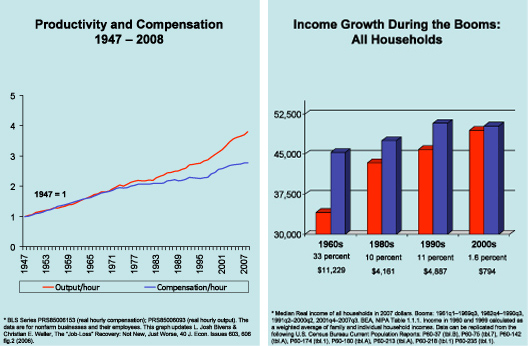
Families have survived the ups and downs of economic booms and busts for a long time, but the fall-behind during the busts has gotten worse while the surge-ahead during the booms has stalled out. In the boom of the 1960s, for example, median family income jumped by 33% (adjusted for inflation). But the boom of the 2000s resulted in an almost-imperceptible 1.6% increase for the typical family. While Wall Street executives and others who owned lots of stock celebrated how good the recovery was for them, middle class families were left empty-handed.
The crisis facing the middle class started more than a generation ago. Even as productivity rose, the wages of the average fully-employed male have been flat since the 1970s.
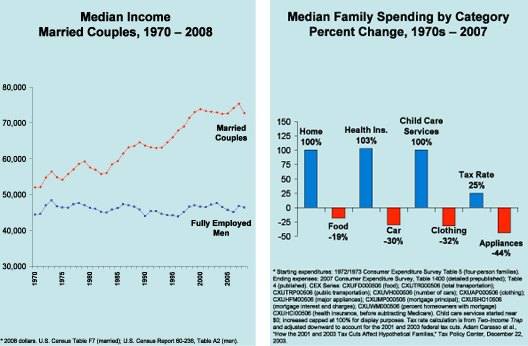
 But core expenses kept going up. By the early 2000s, families were spending twice as much (adjusted for inflation) on mortgages than they did a generation ago -- for a house that was, on average, only ten percent bigger and 25 years older. They also had to pay twice as much to hang on to their health insurance.
To cope, millions of families put a second parent into the workforce. But higher housing and medical costs combined with new expenses for child care, the costs of a second car to get to work and higher taxes combined to squeeze families even harder. Even with two incomes, they tightened their belts. Families today spend less than they did a generation ago on food, clothing, furniture, appliances, and other flexible purchases -- but it hasn't been enough to save them. Today's families have spent all their income, have spent all their savings, and have gone into debt to pay for college, to cover serious medical problems, and just to stay afloat a little while longer.
But core expenses kept going up. By the early 2000s, families were spending twice as much (adjusted for inflation) on mortgages than they did a generation ago -- for a house that was, on average, only ten percent bigger and 25 years older. They also had to pay twice as much to hang on to their health insurance.
To cope, millions of families put a second parent into the workforce. But higher housing and medical costs combined with new expenses for child care, the costs of a second car to get to work and higher taxes combined to squeeze families even harder. Even with two incomes, they tightened their belts. Families today spend less than they did a generation ago on food, clothing, furniture, appliances, and other flexible purchases -- but it hasn't been enough to save them. Today's families have spent all their income, have spent all their savings, and have gone into debt to pay for college, to cover serious medical problems, and just to stay afloat a little while longer.
 Through it all, families never asked for a handout from anyone, especially Washington. They were left to go on their own, working harder, squeezing nickels, and taking care of themselves. But their economic boats have been taking on water for years, and now the crisis has swamped millions of middle class families.
The contrast with the big banks could not be sharper. While the middle class has been caught in an economic vise, the financial industry that was supposed to serve them has prospered at their expense. Consumer banking -- selling debt to middle class families -- has been a gold mine. Boring banking has given way to creative banking, and the industry has generated tens of billions of dollars annually in fees made possible by deceptive and dangerous terms buried in the fine print of opaque, incomprehensible, and largely unregulated contracts.
And when various forms of this creative banking triggered economic crisis, the banks went to Washington for a handout. All the while, top executives kept their jobs and retained their bonuses. Even though the tax dollars that supported the bailout came largely from middle class families -- from people already working hard to make ends meet -- the beneficiaries of those tax dollars are now lobbying Congress to preserve the rules that had let those huge banks feast off the middle class.
Pundits talk about "populist rage" as a way to trivialize the anger and fear coursing through the middle class. But they have it wrong. Families understand with crystalline clarity that the rules they have played by are not the same rules that govern Wall Street. They understand that no American family is "too big to fail." They recognize that business models have shifted and that big banks are pulling out all the stops to squeeze families and boost revenues. They understand that their economic security is under assault and that leaving consumer debt effectively unregulated does not work.
Families are ready for change. According to polls, large majorities of Americans have welcomed the Obama Administration's proposal for a new Consumer Financial Protection Agency (CFPA). The CFPA would be answerable to consumers -- not to banks and not to Wall Street. The agency would have the power to end tricks-and-traps pricing and to start leveling the playing field so that consumers have the tools they need to compare prices and manage their money. The response of the big banks has been to swing into action against the Agency, fighting with all their lobbying might to keep business-as-usual. They are pulling out all the stops to kill the agency before it is born. And if those practices crush millions more families, who cares -- so long as the profits stay high and the bonuses keep coming.
America today has plenty of rich and super-rich. But it has far more families who did all the right things, but who still have no real security. Going to college and finding a good job no longer guarantee economic safety. Paying for a child's education and setting aside enough for a decent retirement have become distant dreams. Tens of millions of once-secure middle class families now live paycheck to paycheck, watching as their debts pile up and worrying about whether a pink slip or a bad diagnosis will send them hurtling over an economic cliff.
America without a strong middle class? Unthinkable, but the once-solid foundation is shaking.
Elizabeth Warren is the Leo Gottlieb Professor of Law at Harvard and is currently the Chair of the Congressional Oversight Panel.
Through it all, families never asked for a handout from anyone, especially Washington. They were left to go on their own, working harder, squeezing nickels, and taking care of themselves. But their economic boats have been taking on water for years, and now the crisis has swamped millions of middle class families.
The contrast with the big banks could not be sharper. While the middle class has been caught in an economic vise, the financial industry that was supposed to serve them has prospered at their expense. Consumer banking -- selling debt to middle class families -- has been a gold mine. Boring banking has given way to creative banking, and the industry has generated tens of billions of dollars annually in fees made possible by deceptive and dangerous terms buried in the fine print of opaque, incomprehensible, and largely unregulated contracts.
And when various forms of this creative banking triggered economic crisis, the banks went to Washington for a handout. All the while, top executives kept their jobs and retained their bonuses. Even though the tax dollars that supported the bailout came largely from middle class families -- from people already working hard to make ends meet -- the beneficiaries of those tax dollars are now lobbying Congress to preserve the rules that had let those huge banks feast off the middle class.
Pundits talk about "populist rage" as a way to trivialize the anger and fear coursing through the middle class. But they have it wrong. Families understand with crystalline clarity that the rules they have played by are not the same rules that govern Wall Street. They understand that no American family is "too big to fail." They recognize that business models have shifted and that big banks are pulling out all the stops to squeeze families and boost revenues. They understand that their economic security is under assault and that leaving consumer debt effectively unregulated does not work.
Families are ready for change. According to polls, large majorities of Americans have welcomed the Obama Administration's proposal for a new Consumer Financial Protection Agency (CFPA). The CFPA would be answerable to consumers -- not to banks and not to Wall Street. The agency would have the power to end tricks-and-traps pricing and to start leveling the playing field so that consumers have the tools they need to compare prices and manage their money. The response of the big banks has been to swing into action against the Agency, fighting with all their lobbying might to keep business-as-usual. They are pulling out all the stops to kill the agency before it is born. And if those practices crush millions more families, who cares -- so long as the profits stay high and the bonuses keep coming.
America today has plenty of rich and super-rich. But it has far more families who did all the right things, but who still have no real security. Going to college and finding a good job no longer guarantee economic safety. Paying for a child's education and setting aside enough for a decent retirement have become distant dreams. Tens of millions of once-secure middle class families now live paycheck to paycheck, watching as their debts pile up and worrying about whether a pink slip or a bad diagnosis will send them hurtling over an economic cliff.
America without a strong middle class? Unthinkable, but the once-solid foundation is shaking.
Elizabeth Warren is the Leo Gottlieb Professor of Law at Harvard and is currently the Chair of the Congressional Oversight Panel.
 But core expenses kept going up. By the early 2000s, families were spending twice as much (adjusted for inflation) on mortgages than they did a generation ago -- for a house that was, on average, only ten percent bigger and 25 years older. They also had to pay twice as much to hang on to their health insurance.
To cope, millions of families put a second parent into the workforce. But higher housing and medical costs combined with new expenses for child care, the costs of a second car to get to work and higher taxes combined to squeeze families even harder. Even with two incomes, they tightened their belts. Families today spend less than they did a generation ago on food, clothing, furniture, appliances, and other flexible purchases -- but it hasn't been enough to save them. Today's families have spent all their income, have spent all their savings, and have gone into debt to pay for college, to cover serious medical problems, and just to stay afloat a little while longer.
But core expenses kept going up. By the early 2000s, families were spending twice as much (adjusted for inflation) on mortgages than they did a generation ago -- for a house that was, on average, only ten percent bigger and 25 years older. They also had to pay twice as much to hang on to their health insurance.
To cope, millions of families put a second parent into the workforce. But higher housing and medical costs combined with new expenses for child care, the costs of a second car to get to work and higher taxes combined to squeeze families even harder. Even with two incomes, they tightened their belts. Families today spend less than they did a generation ago on food, clothing, furniture, appliances, and other flexible purchases -- but it hasn't been enough to save them. Today's families have spent all their income, have spent all their savings, and have gone into debt to pay for college, to cover serious medical problems, and just to stay afloat a little while longer.
 Through it all, families never asked for a handout from anyone, especially Washington. They were left to go on their own, working harder, squeezing nickels, and taking care of themselves. But their economic boats have been taking on water for years, and now the crisis has swamped millions of middle class families.
The contrast with the big banks could not be sharper. While the middle class has been caught in an economic vise, the financial industry that was supposed to serve them has prospered at their expense. Consumer banking -- selling debt to middle class families -- has been a gold mine. Boring banking has given way to creative banking, and the industry has generated tens of billions of dollars annually in fees made possible by deceptive and dangerous terms buried in the fine print of opaque, incomprehensible, and largely unregulated contracts.
And when various forms of this creative banking triggered economic crisis, the banks went to Washington for a handout. All the while, top executives kept their jobs and retained their bonuses. Even though the tax dollars that supported the bailout came largely from middle class families -- from people already working hard to make ends meet -- the beneficiaries of those tax dollars are now lobbying Congress to preserve the rules that had let those huge banks feast off the middle class.
Pundits talk about "populist rage" as a way to trivialize the anger and fear coursing through the middle class. But they have it wrong. Families understand with crystalline clarity that the rules they have played by are not the same rules that govern Wall Street. They understand that no American family is "too big to fail." They recognize that business models have shifted and that big banks are pulling out all the stops to squeeze families and boost revenues. They understand that their economic security is under assault and that leaving consumer debt effectively unregulated does not work.
Families are ready for change. According to polls, large majorities of Americans have welcomed the Obama Administration's proposal for a new Consumer Financial Protection Agency (CFPA). The CFPA would be answerable to consumers -- not to banks and not to Wall Street. The agency would have the power to end tricks-and-traps pricing and to start leveling the playing field so that consumers have the tools they need to compare prices and manage their money. The response of the big banks has been to swing into action against the Agency, fighting with all their lobbying might to keep business-as-usual. They are pulling out all the stops to kill the agency before it is born. And if those practices crush millions more families, who cares -- so long as the profits stay high and the bonuses keep coming.
America today has plenty of rich and super-rich. But it has far more families who did all the right things, but who still have no real security. Going to college and finding a good job no longer guarantee economic safety. Paying for a child's education and setting aside enough for a decent retirement have become distant dreams. Tens of millions of once-secure middle class families now live paycheck to paycheck, watching as their debts pile up and worrying about whether a pink slip or a bad diagnosis will send them hurtling over an economic cliff.
America without a strong middle class? Unthinkable, but the once-solid foundation is shaking.
Elizabeth Warren is the Leo Gottlieb Professor of Law at Harvard and is currently the Chair of the Congressional Oversight Panel.
Through it all, families never asked for a handout from anyone, especially Washington. They were left to go on their own, working harder, squeezing nickels, and taking care of themselves. But their economic boats have been taking on water for years, and now the crisis has swamped millions of middle class families.
The contrast with the big banks could not be sharper. While the middle class has been caught in an economic vise, the financial industry that was supposed to serve them has prospered at their expense. Consumer banking -- selling debt to middle class families -- has been a gold mine. Boring banking has given way to creative banking, and the industry has generated tens of billions of dollars annually in fees made possible by deceptive and dangerous terms buried in the fine print of opaque, incomprehensible, and largely unregulated contracts.
And when various forms of this creative banking triggered economic crisis, the banks went to Washington for a handout. All the while, top executives kept their jobs and retained their bonuses. Even though the tax dollars that supported the bailout came largely from middle class families -- from people already working hard to make ends meet -- the beneficiaries of those tax dollars are now lobbying Congress to preserve the rules that had let those huge banks feast off the middle class.
Pundits talk about "populist rage" as a way to trivialize the anger and fear coursing through the middle class. But they have it wrong. Families understand with crystalline clarity that the rules they have played by are not the same rules that govern Wall Street. They understand that no American family is "too big to fail." They recognize that business models have shifted and that big banks are pulling out all the stops to squeeze families and boost revenues. They understand that their economic security is under assault and that leaving consumer debt effectively unregulated does not work.
Families are ready for change. According to polls, large majorities of Americans have welcomed the Obama Administration's proposal for a new Consumer Financial Protection Agency (CFPA). The CFPA would be answerable to consumers -- not to banks and not to Wall Street. The agency would have the power to end tricks-and-traps pricing and to start leveling the playing field so that consumers have the tools they need to compare prices and manage their money. The response of the big banks has been to swing into action against the Agency, fighting with all their lobbying might to keep business-as-usual. They are pulling out all the stops to kill the agency before it is born. And if those practices crush millions more families, who cares -- so long as the profits stay high and the bonuses keep coming.
America today has plenty of rich and super-rich. But it has far more families who did all the right things, but who still have no real security. Going to college and finding a good job no longer guarantee economic safety. Paying for a child's education and setting aside enough for a decent retirement have become distant dreams. Tens of millions of once-secure middle class families now live paycheck to paycheck, watching as their debts pile up and worrying about whether a pink slip or a bad diagnosis will send them hurtling over an economic cliff.
America without a strong middle class? Unthinkable, but the once-solid foundation is shaking.
Elizabeth Warren is the Leo Gottlieb Professor of Law at Harvard and is currently the Chair of the Congressional Oversight Panel.
Thursday, November 19, 2009
Interview with Elizabeth Warren on CNBC - 9:30
Pretty good interview with Elizabeth Warren on CNBC about TARP and the economy.
Subscribe to:
Posts (Atom)

