
Showing posts with label GS. Show all posts
Showing posts with label GS. Show all posts
Thursday, December 24, 2009
NYT article on Goldman Sachs and the housing meltdown - how they bet against us - Bonus - Christmas Eve.
December 24, 2009
Banks Bundled Bad Debt, Bet Against It and Won
By GRETCHEN MORGENSON and LOUISE STORY
In late October 2007, as the financial markets were starting to come unglued, a Goldman Sachs trader, Jonathan M. Egol, received very good news. At 37, he was named a managing director at the firm.
Mr. Egol, a Princeton graduate, had risen to prominence inside the bank by creating mortgage-related securities, named Abacus, that were at first intended to protect Goldman from investment losses if the housing market collapsed. As the market soured, Goldman created even more of these securities, enabling it to pocket huge profits.
Goldman’s own clients who bought them, however, were less fortunate.
Pension funds and insurance companies lost billions of dollars on securities that they believed were solid investments, according to former Goldman employees with direct knowledge of the deals who asked not to be identified because they have confidentiality agreements with the firm.
Goldman was not the only firm that peddled these complex securities — known as synthetic collateralized debt obligations, or C.D.O.’s — and then made financial bets against them, called selling short in Wall Street parlance. Others that created similar securities and then bet they would fail, according to Wall Street traders, include Deutsche Bank and Morgan Stanley, as well as smaller firms like Tricadia Inc., an investment company whose parent firm was overseen by Lewis A. Sachs, who this year became a special counselor to Treasury Secretary Timothy F. Geithner.
How these disastrously performing securities were devised is now the subject of scrutiny by investigators in Congress, at the Securities and Exchange Commission and at the Financial Industry Regulatory Authority, Wall Street’s self-regulatory organization, according to people briefed on the investigations. Those involved with the inquiries declined to comment.
While the investigations are in the early phases, authorities appear to be looking at whether securities laws or rules of fair dealing were violated by firms that created and sold these mortgage-linked debt instruments and then bet against the clients who purchased them, people briefed on the matter say.
One focus of the inquiry is whether the firms creating the securities purposely helped to select especially risky mortgage-linked assets that would be most likely to crater, setting their clients up to lose billions of dollars if the housing market imploded.
Some securities packaged by Goldman and Tricadia ended up being so vulnerable that they soured within months of being created.
Goldman and other Wall Street firms maintain there is nothing improper about synthetic C.D.O.’s, saying that they typically employ many trading techniques to hedge investments and protect against losses. They add that many prudent investors often do the same. Goldman used these securities initially to offset any potential losses stemming from its positive bets on mortgage securities.
But Goldman and other firms eventually used the C.D.O.’s to place unusually large negative bets that were not mainly for hedging purposes, and investors and industry experts say that put the firms at odds with their own clients’ interests.
“The simultaneous selling of securities to customers and shorting them because they believed they were going to default is the most cynical use of credit information that I have ever seen,” said Sylvain R. Raynes, an expert in structured finance at R & R Consulting in New York. “When you buy protection against an event that you have a hand in causing, you are buying fire insurance on someone else’s house and then committing arson.”
Investment banks were not alone in reaping rich rewards by placing trades against synthetic C.D.O.’s. Some hedge funds also benefited, including Paulson & Company, according to former Goldman workers and people at other banks familiar with that firm’s trading.
Michael DuVally, a Goldman Sachs spokesman, declined to make Mr. Egol available for comment. But Mr. DuVally said many of the C.D.O.’s created by Wall Street were made to satisfy client demand for such products, which the clients thought would produce profits because they had an optimistic view of the housing market. In addition, he said that clients knew Goldman might be betting against mortgages linked to the securities, and that the buyers of synthetic mortgage C.D.O.’s were large, sophisticated investors, he said.
The creation and sale of synthetic C.D.O.’s helped make the financial crisis worse than it might otherwise have been, effectively multiplying losses by providing more securities to bet against. Some $8 billion in these securities remain on the books at American International Group, the giant insurer rescued by the government in September 2008.
From 2005 through 2007, at least $108 billion in these securities was issued, according to Dealogic, a financial data firm. And the actual volume was much higher because synthetic C.D.O.’s and other customized trades are unregulated and often not reported to any financial exchange or market.
Goldman Saw It Coming
Before the financial crisis, many investors — large American and European banks, pension funds, insurance companies and even some hedge funds — failed to recognize that overextended borrowers would default on their mortgages, and they kept increasing their investments in mortgage-related securities. As the mortgage market collapsed, they suffered steep losses.
A handful of investors and Wall Street traders, however, anticipated the crisis. In 2006, Wall Street had introduced a new index, called the ABX, that became a way to invest in the direction of mortgage securities. The index allowed traders to bet on or against pools of mortgages with different risk characteristics, just as stock indexes enable traders to bet on whether the overall stock market, or technology stocks or bank stocks, will go up or down.
Goldman, among others on Wall Street, has said since the collapse that it made big money by using the ABX to bet against the housing market. Worried about a housing bubble, top Goldman executives decided in December 2006 to change the firm’s overall stance on the mortgage market, from positive to negative, though it did not disclose that publicly.
Even before then, however, pockets of the investment bank had also started using C.D.O.’s to place bets against mortgage securities, in some cases to hedge the firm’s mortgage investments, as protection against a fall in housing prices and an increase in defaults.
Mr. Egol was a prime mover behind these securities. Beginning in 2004, with housing prices soaring and the mortgage mania in full swing, Mr. Egol began creating the deals known as Abacus. From 2004 to 2008, Goldman issued 25 Abacus deals, according to Bloomberg, with a total value of $10.9 billion.
Abacus allowed investors to bet for or against the mortgage securities that were linked to the deal. The C.D.O.’s didn’t contain actual mortgages. Instead, they consisted of credit-default swaps, a type of insurance that pays out when a borrower defaults. These swaps made it much easier to place large bets on mortgage failures.
Rather than persuading his customers to make negative bets on Abacus, Mr. Egol kept most of these wagers for his firm, said five former Goldman employees who spoke on the condition of anonymity. On occasion, he allowed some hedge funds to take some of the short trades.
Mr. Egol and Fabrice Tourre, a French trader at Goldman, were aggressive from the start in trying to make the assets in Abacus deals look better than they were, according to notes taken by a Wall Street investor during a phone call with Mr. Tourre and another Goldman employee in May 2005.
On the call, the two traders noted that they were trying to persuade analysts at Moody’s Investors Service, a credit rating agency, to assign a higher rating to one part of an Abacus C.D.O. but were having trouble, according to the investor’s notes, which were provided by a colleague who asked for anonymity because he was not authorized to release them. Goldman declined to discuss the selection of the assets in the C.D.O.’s, but a spokesman said investors could have rejected the C.D.O. if they did not like the assets.
Goldman’s bets against the performances of the Abacus C.D.O.’s were not worth much in 2005 and 2006, but they soared in value in 2007 and 2008 when the mortgage market collapsed. The trades gave Mr. Egol a higher profile at the bank, and he was among a group promoted to managing director on Oct. 24, 2007.
“Egol and Fabrice were way ahead of their time,” said one of the former Goldman workers. “They saw the writing on the wall in this market as early as 2005.” By creating the Abacus C.D.O.’s, they helped protect Goldman against losses that others would suffer.
As early as the summer of 2006, Goldman’s sales desk began marketing short bets using the ABX index to hedge funds like Paulson & Company, Magnetar and Soros Fund Management, which invests for the billionaire George Soros. John Paulson, the founder of Paulson & Company, also would later take some of the shorts from the Abacus deals, helping him profit when mortgage bonds collapsed. He declined to comment.
A Deal Gone Bad, for Some
The woeful performance of some C.D.O.’s issued by Goldman made them ideal for betting against. As of September 2007, for example, just five months after Goldman had sold a new Abacus C.D.O., the ratings on 84 percent of the mortgages underlying it had been downgraded, indicating growing concerns about borrowers’ ability to repay the loans, according to research from UBS, the big Swiss bank. Of more than 500 C.D.O.’s analyzed by UBS, only two were worse than the Abacus deal.
Goldman created other mortgage-linked C.D.O.’s that performed poorly, too. One, in October 2006, was a $800 million C.D.O. known as Hudson Mezzanine. It included credit insurance on mortgage and subprime mortgage bonds that were in the ABX index; Hudson buyers would make money if the housing market stayed healthy — but lose money if it collapsed. Goldman kept a significant amount of the financial bets against securities in Hudson, so it would profit if they failed, according to three of the former Goldman employees.
A Goldman salesman involved in Hudson said the deal was one of the earliest in which outside investors raised questions about Goldman’s incentives. “Here we are selling this, but we think the market is going the other way,” he said.
A hedge fund investor in Hudson, who spoke on the condition of anonymity, said that because Goldman was betting against the deal, he wondered whether the bank built Hudson with “bonds they really think are going to get into trouble.”
Indeed, Hudson investors suffered large losses. In March 2008, just 18 months after Goldman created that C.D.O., so many borrowers had defaulted that holders of the security paid out about $310 million to Goldman and others who had bet against it, according to correspondence sent to Hudson investors.
The Goldman salesman said that C.D.O. buyers were not misled because they were advised that Goldman was placing large bets against the securities. “We were very open with all the risks that we thought we sold. When you’re facing a tidal wave of people who want to invest, it’s hard to stop them,” he said. The salesman added that investors could have placed bets against Abacus and similar C.D.O.’s if they had wanted to.
A Goldman spokesman said the firm’s negative bets didn’t keep it from suffering losses on its mortgage assets, taking $1.7 billion in write-downs on them in 2008; but he would not say how much the bank had since earned on its short positions, which former Goldman workers say will be far more lucrative over time. For instance, Goldman profited to the tune of $1.5 billion from one series of mortgage-related trades by Mr. Egol with Wall Street rival Morgan Stanley, which had to book a steep loss, according to people at both firms.
Tetsuya Ishikawa, a salesman on several Abacus and Hudson deals, left Goldman and later published a novel, “How I Caused the Credit Crunch.” In it, he wrote that bankers deserted their clients who had bought mortgage bonds when that market collapsed: “We had moved on to hurting others in our quest for self-preservation.” Mr. Ishikawa, who now works for another financial firm in London, declined to comment on his work at Goldman.
Profits From a Collapse
Just as synthetic C.D.O.’s began growing rapidly, some Wall Street banks pushed for technical modifications governing how they worked in ways that made it possible for C.D.O.’s to expand even faster, and also tilted the playing field in favor of banks and hedge funds that bet against C.D.O.’s, according to investors.
In early 2005, a group of prominent traders met at Deutsche Bank’s office in New York and drew up a new system, called Pay as You Go. This meant the insurance for those betting against mortgages would pay out more quickly. The traders then went to the International Swaps and Derivatives Association, the group that governs trading in derivatives like C.D.O.’s. The new system was presented as a fait accompli, and adopted.
Other changes also increased the likelihood that investors would suffer losses if the mortgage market tanked. Previously, investors took losses only in certain dire “credit events,” as when the mortgages associated with the C.D.O. defaulted or their issuers went bankrupt.
But the new rules meant that C.D.O. holders would have to make payments to short sellers under less onerous outcomes, or “triggers,” like a ratings downgrade on a bond. This meant that anyone who bet against a C.D.O. could collect on the bet more easily.
“In the early deals you see none of these triggers,” said one investor who asked for anonymity to preserve relationships. “These things were built in to provide the dealers with a big payoff when something bad happened.”
Banks also set up ever more complex deals that favored those betting against C.D.O.’s. Morgan Stanley established a series of C.D.O.’s named after United States presidents (Buchanan and Jackson) with an unusual feature: short-sellers could lock in very cheap bets against mortgages, even beyond the life of the mortgage bonds. It was akin to allowing someone paying a low insurance premium for coverage on one automobile to pay the same on another one even if premiums over all had increased because of high accident rates.
At Goldman, Mr. Egol structured some Abacus deals in a way that enabled those betting on a mortgage-market collapse to multiply the value of their bets, to as much as six or seven times the face value of those C.D.O.’s. When the mortgage market tumbled, this meant bigger profits for Goldman and other short sellers — and bigger losses for other investors.
Selling Bad Debt
Other Wall Street firms also created risky mortgage-related securities that they bet against.
At Deutsche Bank, the point man on betting against the mortgage market was Greg Lippmann, a trader. Mr. Lippmann made his pitch to select hedge fund clients, arguing they should short the mortgage market. He sometimes distributed a T-shirt that read “I’m Short Your House!!!” in black and red letters.
Deutsche, which declined to comment, at the same time was selling synthetic C.D.O.’s to its clients, and those deals created more short-selling opportunities for traders like Mr. Lippmann.
Among the most aggressive C.D.O. creators was Tricadia, a management company that was a unit of Mariner Investment Group. Until he became a senior adviser to the Treasury secretary early this year, Lewis Sachs was Mariner’s vice chairman. Mr. Sachs oversaw about 20 portfolios there, including Tricadia, and its documents also show that Mr. Sachs sat atop the firm’s C.D.O. management committee.
From 2003 to 2007, Tricadia issued 14 mortgage-linked C.D.O.’s, which it called TABS. Even when the market was starting to implode, Tricadia continued to create TABS deals in early 2007 to sell to investors. The deal documents referring to conflicts of interest stated that affiliates and clients of Tricadia might place bets against the types of securities in the TABS deal.
Even so, the sales material also boasted that the mortgages linked to C.D.O.’s had historically low default rates, citing a “recently completed” study by Standard & Poor’s ratings agency — though fine print indicated that the date of the study was September 2002, almost five years earlier.
At a financial symposium in New York in September 2006, Michael Barnes, the co-head of Tricadia, described how a hedge fund could put on a negative mortgage bet by shorting assets to C.D.O. investors, according to his presentation, which was reviewed by The New York Times.
Mr. Barnes declined to comment. James E. McKee, general counsel at Tricadia, said, “Tricadia has never shorted assets into the TABS deals, and Tricadia has always acted in the best interests of its clients and investors.”
Mr. Sachs, through a spokesman at the Treasury Department, declined to comment.
Like investors in some of Goldman’s Abacus deals, buyers of some TABS experienced heavy losses. By the end of 2007, UBS research showed that two TABS deals were the eighth- and ninth-worst performing C.D.O.’s. Both had been downgraded on at least 75 percent of their associated assets within a year of being issued.
Tricadia’s hedge fund did far better, earning roughly a 50 percent return in 2007 and similar profits in 2008, in part from the short bets.


Monday, July 20, 2009
Market wrap - 4:15PM
This rocketship of a market continues, on no volume of course. But maybe the upgrade from Goldman Sachs this morning had something to do with it.
Dow 8,847.93 +103.99 (1.19%)
S&P 500 950.97 +10.59 (1.13%)
Nasdaq 1,909.29 +22.68 (1.20%)
Gold 949 +11 +1.21%
Oil 64.33 0.42 0.66%
Today by sector:
 Today's heatmap:
 Tomorrow morning earnings:

Any minute now, CNBC will have Nouriel Roubini on to explain his call last week "the recession will end by the end of the year" that CNBC made, which drove the marke up that day. Roubini later came out and said he never said that. In case you are not familiar with Roubini, he is known as Dr. Doom, for forecasting this crisis back in 2006. He has been mocked repeatedly by CNBC over the last year, and quite often and increasingly worse in the last few months. The new main pumper of Fast Money, Joe "buy everything in sight" Terranova took another shot at him today when he said something to the effect "I am long whatever Roubini is short" or something like that. Screw you Joe, you have the credibility of a turd. I will post the interview if they put in on their website. Watch for the earnings reports from Texas Instruments after the bell today. The spin doctors will use this tonight and tomorrow to pump this bullshit market even higher - if anyone other than Goldman Sachs is trading it.
 Today's heatmap:
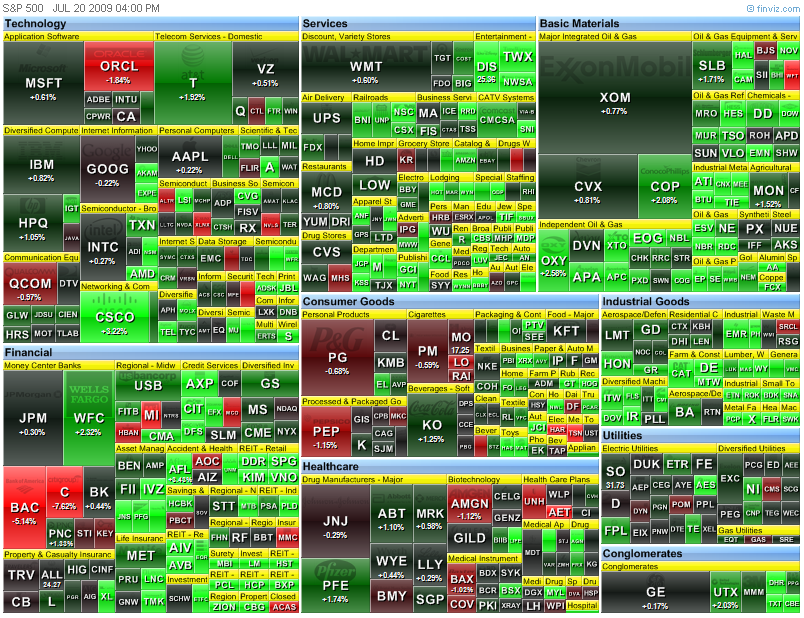 Tomorrow morning earnings:

Any minute now, CNBC will have Nouriel Roubini on to explain his call last week "the recession will end by the end of the year" that CNBC made, which drove the marke up that day. Roubini later came out and said he never said that. In case you are not familiar with Roubini, he is known as Dr. Doom, for forecasting this crisis back in 2006. He has been mocked repeatedly by CNBC over the last year, and quite often and increasingly worse in the last few months. The new main pumper of Fast Money, Joe "buy everything in sight" Terranova took another shot at him today when he said something to the effect "I am long whatever Roubini is short" or something like that. Screw you Joe, you have the credibility of a turd. I will post the interview if they put in on their website. Watch for the earnings reports from Texas Instruments after the bell today. The spin doctors will use this tonight and tomorrow to pump this bullshit market even higher - if anyone other than Goldman Sachs is trading it.
Goldman Ups S&P 500 Target for End-Year - 9:07AM
Goldman Ups S&P 500 Target for End-Year - CNBC (sorry to send you there)
Goldman Sachs raised the S&P 500 index's target for the end of the year to 1060 from 940 Monday, but said the risk of "double-dip" recession remains significant.
Goldman Sachs made the move to reflect potential price return of about 13 percent from the current levels, Reuters reported.
It also raised the S&P 500 operating earnings view to $52 from $40 for this year.
Operating earnings view for next year was also raised to $75 from $63.
Goldman's current economic view is for below-trend growth through 2010, and it believes the risk of a "double-dip" recession is still significant.
Asian markets rallied, with the Hang Seng index closing more than 3.7 percent up, while European stock indexes were also up, with banks dominating the upturn.
Stock markets in the US and Europe are likely to see a significant rally if indexes manage to rise further from current levels, technical analyst Clem Chambers, CEO of ADVFN, also said Monday.
© 2009 CNBC.com
Really! Goldman Sachs - upgrading the price target of the S&P - sound familiar? Oil, other banks, etc? At this point, I don't believe anything these people say.
Really! Goldman Sachs - upgrading the price target of the S&P - sound familiar? Oil, other banks, etc? At this point, I don't believe anything these people say.
Friday, July 17, 2009
CIT in talks with Goldman and another Wall Street bank for financing - 12:50PM
Reported on CNBC but no details as of yet. I will post them when I can find some.
Update - 1:17 CIT soars on report of financing talks with banks - from MarketWatch SAN FRANCISCO (MarketWatch) -- CIT Group Inc. (CIT 0.90, +0.49, +119.51%) shares soared during Friday afternoon trading after Reuters reported that the troubled lender is in talks with J.P. Morgan Chase (JPM 36.61, +0.48, +1.32%) and Goldman Sachs (GS 156.09, -0.75, -0.48%) for short-term financing of $2 billion to $3 billion. CIT shares jumped 40 cents to 81 cents in afternoon action on Friday. A CIT spokesman didn't immediately respond to a phone call and email seeking comment.
Good, taxpayers have done enough of the bailouts, JPM and GS have plenty of our money.
Update - 1:17 CIT soars on report of financing talks with banks - from MarketWatch SAN FRANCISCO (MarketWatch) -- CIT Group Inc. (CIT 0.90, +0.49, +119.51%) shares soared during Friday afternoon trading after Reuters reported that the troubled lender is in talks with J.P. Morgan Chase (JPM 36.61, +0.48, +1.32%) and Goldman Sachs (GS 156.09, -0.75, -0.48%) for short-term financing of $2 billion to $3 billion. CIT shares jumped 40 cents to 81 cents in afternoon action on Friday. A CIT spokesman didn't immediately respond to a phone call and email seeking comment.
Good, taxpayers have done enough of the bailouts, JPM and GS have plenty of our money.
Tuesday, July 14, 2009
Since today is declared Goldman Sachs day - here is a video from Bloomberg worth watching.
Not that I am a fan of Elliot Spitzer, this is a pretty good interview just the same;
Not a big fan of Charle Gasparino either, but he's right on this one, and from the CNBC cheerleader station as well;
Goldman Sachs - Monster Quarter - 8:45AM
Shocked? Not me, I expected this. When you are in bed with the government, and their bailout money, who wouldn't make a profit?
From MarketWatch
By Greg Morcroft
NEW YORK (MarketWatch) -- Goldman Sachs Group Inc said on Tuesday that its second quarter net income rose to $3.44 billion, or $4.93 a share, compared to $2.05 billion, or $4.58 a share a year ago. Analysts polled by Thomson Reuters had expected the company to earn $3.54 a share in the quarter. Net revenues at the firm were $13.76 billion in the second quarter, compared to $9.42 billion last year. Goldman switched from a fiscal reporting schedule to a calendar schedule last year, and this year's second quarter ended in June, while the year ago data is for the period ended May 31, 2008.
We also have this: CIT Group, which gives credit to many businesses is having a hard time recently: As their chart shows, they have been dropping quite severely, but the last two days have been really bad. But, not to worry, from Bloomberg we see this - CIT Rises on ‘Active’ Talks for U.S. Aid Before Debt Maturity - really?
From the article - July 14 (Bloomberg) -- CIT Group Inc. rose in European trading after the corporate lender said it’s in “active discussions” with regulators about a rescue before $1 billion of bonds mature next month.
ANOTHER RESCUSE/BAILOUT? Screw that, we the taxpayers have given these damn financial companies enough money. Here's an idea - LET GOLDMAN SACHS BAIL THEIR ASS OUT.
By the way, they are up over 18 percent pre-market. Investors (cough, cough) ready to jump on the government backed gravy train. Err...I mean taxpayer backed gravy train. The robbing and pillaging continues.
As their chart shows, they have been dropping quite severely, but the last two days have been really bad. But, not to worry, from Bloomberg we see this - CIT Rises on ‘Active’ Talks for U.S. Aid Before Debt Maturity - really?
From the article - July 14 (Bloomberg) -- CIT Group Inc. rose in European trading after the corporate lender said it’s in “active discussions” with regulators about a rescue before $1 billion of bonds mature next month.
ANOTHER RESCUSE/BAILOUT? Screw that, we the taxpayers have given these damn financial companies enough money. Here's an idea - LET GOLDMAN SACHS BAIL THEIR ASS OUT.
By the way, they are up over 18 percent pre-market. Investors (cough, cough) ready to jump on the government backed gravy train. Err...I mean taxpayer backed gravy train. The robbing and pillaging continues.
We also have this: CIT Group, which gives credit to many businesses is having a hard time recently:
 As their chart shows, they have been dropping quite severely, but the last two days have been really bad. But, not to worry, from Bloomberg we see this - CIT Rises on ‘Active’ Talks for U.S. Aid Before Debt Maturity - really?
From the article - July 14 (Bloomberg) -- CIT Group Inc. rose in European trading after the corporate lender said it’s in “active discussions” with regulators about a rescue before $1 billion of bonds mature next month.
ANOTHER RESCUSE/BAILOUT? Screw that, we the taxpayers have given these damn financial companies enough money. Here's an idea - LET GOLDMAN SACHS BAIL THEIR ASS OUT.
By the way, they are up over 18 percent pre-market. Investors (cough, cough) ready to jump on the government backed gravy train. Err...I mean taxpayer backed gravy train. The robbing and pillaging continues.
As their chart shows, they have been dropping quite severely, but the last two days have been really bad. But, not to worry, from Bloomberg we see this - CIT Rises on ‘Active’ Talks for U.S. Aid Before Debt Maturity - really?
From the article - July 14 (Bloomberg) -- CIT Group Inc. rose in European trading after the corporate lender said it’s in “active discussions” with regulators about a rescue before $1 billion of bonds mature next month.
ANOTHER RESCUSE/BAILOUT? Screw that, we the taxpayers have given these damn financial companies enough money. Here's an idea - LET GOLDMAN SACHS BAIL THEIR ASS OUT.
By the way, they are up over 18 percent pre-market. Investors (cough, cough) ready to jump on the government backed gravy train. Err...I mean taxpayer backed gravy train. The robbing and pillaging continues.
Monday, July 13, 2009
Meredith Whitney ups Goldman Sachs - 8:55AM
Wow! Meredith Whitney on CNBC jammed the banking system up, especially Goldman Sachs, Bank of America and JP Morgan. Did she go over to the dark side, or did she find out having her own firm made her find out you only give bullish ratings:
From Bloomberg:
U.S. Stock-Index Futures Climb; Goldman Sachs Gains on Upgrade
By Roger Neill
July 13 (Bloomberg) -- U.S. stock index futures advanced as Goldman Sachs Group Inc. gained in early trading in New York after Meredith Whitney Advisory Group LLC recommended buying the shares before the bank reports earnings tomorrow.
Standard & Poor’s 500 Index futures expiring in September climbed 0.3 percent to 877.20 at 8:20 a.m. in New York, having lost as much as 1 percent earlier.
Saturday, July 11, 2009
Missed by .19 - quite impressive actually - The battle of Bulls & Bears - Update Saturday 1:00PM
In the charts below you will see a classic Head & Shoulders pattern on the S&P500 chart. The pattern has been developing since the beginning of May. You can see this on the following chart:
 The important thing to notice is the neckline, at the 878.94 level, established by the candle (low wick)on 5/15/09. This level is just a tad below the other neckline candle on 7/7/09. This low is a little higher at 879.93. This pattern is known as a reversal pattern. Since the March 6th low, or the March 9th closing low, the market has been on an uptrend, so a reversal would be signifying the market is turning and heading lower.
Much to the chagrin of the Government, who would like us to think everything is getting better, and the All Star cheerleaders on CNBC, who's on a mission to pump it higher for their parent company GE (and their buddies on Wall Street, especially the banks) this line represents the confirmation of the reversal. In other words, once this line is breached, and closes below this level, the Bears will come out of hibernation and short the market.
You can see the battle of the Bulls & Bears and how this line has been successfully defended (so far) by the Bulls with this chart. The numbers above the candles designate the closing:
The important thing to notice is the neckline, at the 878.94 level, established by the candle (low wick)on 5/15/09. This level is just a tad below the other neckline candle on 7/7/09. This low is a little higher at 879.93. This pattern is known as a reversal pattern. Since the March 6th low, or the March 9th closing low, the market has been on an uptrend, so a reversal would be signifying the market is turning and heading lower.
Much to the chagrin of the Government, who would like us to think everything is getting better, and the All Star cheerleaders on CNBC, who's on a mission to pump it higher for their parent company GE (and their buddies on Wall Street, especially the banks) this line represents the confirmation of the reversal. In other words, once this line is breached, and closes below this level, the Bears will come out of hibernation and short the market.
You can see the battle of the Bulls & Bears and how this line has been successfully defended (so far) by the Bulls with this chart. The numbers above the candles designate the closing:
 In the last three days, notice how small the trading range has been? Also, the intraday range has broken this line, but the Bulls have successfully pushed it back above. This pattern was the hot topic on CNBC this week, or at least the last three days. It has been talked about on many blogs and trading sights as well. As usual, CNBC is a day late. But they did their homework, and went back far enough on a chart to call this "a possible" inverse head and shoulders, which means a reversal to the upside. Good grief!
Friday, they were talking to Steve "this market is going higher" Grasso about where the market is going. This was some time in the early afternoon. His answer was "if it closes above 880, this market is going higher next week." Really? Of course it might, and I assume he was talking about the neckline at 878.94, but I won't get too technical on him. As you can see by the chart above, this line has been quite the battle for the last three days. But as Bob Pisoni would say "the important thing is" the line was defended and the market is set to the upside.
Earnings season is upon us, with Alcoa the first DOW component to report this last week. Some of the large banks are due to report next week, including Goldman Sachs on Tuesday, followed by JP Morgan on Thursday. Friday is littered with Citigroup, Bank of America and GE, who trades like a bank. None of these companies are in very good shape, if you go by their recent stock performance (the ones that report on Friday).
In the grand plan of bullshitting the people, this market needs to be pumped up. With earnings expectations lowered to a level easy enough for a cave man to make them, I expect some companies (especially a bank or two, most likely GS) to report the "better than expected" earnings next week.
As long as this neckline is defended by the Bulls, the better than expected earnings by the banks will drive this market higher, along with the slobbering CNBC cheerleaders. We will hear "Green Shoots" galore and "the big money is getting off the sidelines, it's time to "buy, buy, buy" will be heard all day. Utopia has arrived in the stock market world. Dennis Kneale who declared the recession over last week (and got into it with the blogesphere for being the idiot that he is)will likely have wet pants while telling us "I told you so."
For this to happen, they needed to defend the neckline. Friday morning Goldman upgraded about every stock in the tech world, after someone upgraded the home builders on Thursday. Home builders? Give me a break. But if you look at the stocks on Thursday, the home builders, casinos and hotels all did very will, helping to drive the market higher. Along with a bunch of other obscure bullshit stocks that nobody has ever heard of. On Friday, along with the Goldman upgrades and a mid to late day surge, with a nice ramp at the end of the day they made their bogey, closing .19 above the neck. Well done! But really, who thinks home builders, casinos and hotels are a good buy?
But I digress. Here is the intraday from Friday's action on the S&P500.
In the last three days, notice how small the trading range has been? Also, the intraday range has broken this line, but the Bulls have successfully pushed it back above. This pattern was the hot topic on CNBC this week, or at least the last three days. It has been talked about on many blogs and trading sights as well. As usual, CNBC is a day late. But they did their homework, and went back far enough on a chart to call this "a possible" inverse head and shoulders, which means a reversal to the upside. Good grief!
Friday, they were talking to Steve "this market is going higher" Grasso about where the market is going. This was some time in the early afternoon. His answer was "if it closes above 880, this market is going higher next week." Really? Of course it might, and I assume he was talking about the neckline at 878.94, but I won't get too technical on him. As you can see by the chart above, this line has been quite the battle for the last three days. But as Bob Pisoni would say "the important thing is" the line was defended and the market is set to the upside.
Earnings season is upon us, with Alcoa the first DOW component to report this last week. Some of the large banks are due to report next week, including Goldman Sachs on Tuesday, followed by JP Morgan on Thursday. Friday is littered with Citigroup, Bank of America and GE, who trades like a bank. None of these companies are in very good shape, if you go by their recent stock performance (the ones that report on Friday).
In the grand plan of bullshitting the people, this market needs to be pumped up. With earnings expectations lowered to a level easy enough for a cave man to make them, I expect some companies (especially a bank or two, most likely GS) to report the "better than expected" earnings next week.
As long as this neckline is defended by the Bulls, the better than expected earnings by the banks will drive this market higher, along with the slobbering CNBC cheerleaders. We will hear "Green Shoots" galore and "the big money is getting off the sidelines, it's time to "buy, buy, buy" will be heard all day. Utopia has arrived in the stock market world. Dennis Kneale who declared the recession over last week (and got into it with the blogesphere for being the idiot that he is)will likely have wet pants while telling us "I told you so."
For this to happen, they needed to defend the neckline. Friday morning Goldman upgraded about every stock in the tech world, after someone upgraded the home builders on Thursday. Home builders? Give me a break. But if you look at the stocks on Thursday, the home builders, casinos and hotels all did very will, helping to drive the market higher. Along with a bunch of other obscure bullshit stocks that nobody has ever heard of. On Friday, along with the Goldman upgrades and a mid to late day surge, with a nice ramp at the end of the day they made their bogey, closing .19 above the neck. Well done! But really, who thinks home builders, casinos and hotels are a good buy?
But I digress. Here is the intraday from Friday's action on the S&P500.
 We all know the housing mess is far from over, and the 800 pound gorilla in the room is Commercial Real Estate, both which can be bought with the ETF known as IYR. Take a look at the intraday chart of IYR on Friday:
 Quite the battle at the end of the day is it not? Let me ask, who in their right mind would buy that much IYR after 3:30 on Friday going into a weekend? Actually, who would buy that crap to begin with? Seems either fishy or just plain dumb to me. There is plenty of pain to come in the world of real estate.
I will be watching this neckline very close (as I have been) and depending on what happens next week, will determine if I go long or short. The neckline is key.
Happy Trading
Quite the battle at the end of the day is it not? Let me ask, who in their right mind would buy that much IYR after 3:30 on Friday going into a weekend? Actually, who would buy that crap to begin with? Seems either fishy or just plain dumb to me. There is plenty of pain to come in the world of real estate.
I will be watching this neckline very close (as I have been) and depending on what happens next week, will determine if I go long or short. The neckline is key.
Happy Trading
 The important thing to notice is the neckline, at the 878.94 level, established by the candle (low wick)on 5/15/09. This level is just a tad below the other neckline candle on 7/7/09. This low is a little higher at 879.93. This pattern is known as a reversal pattern. Since the March 6th low, or the March 9th closing low, the market has been on an uptrend, so a reversal would be signifying the market is turning and heading lower.
Much to the chagrin of the Government, who would like us to think everything is getting better, and the All Star cheerleaders on CNBC, who's on a mission to pump it higher for their parent company GE (and their buddies on Wall Street, especially the banks) this line represents the confirmation of the reversal. In other words, once this line is breached, and closes below this level, the Bears will come out of hibernation and short the market.
You can see the battle of the Bulls & Bears and how this line has been successfully defended (so far) by the Bulls with this chart. The numbers above the candles designate the closing:
The important thing to notice is the neckline, at the 878.94 level, established by the candle (low wick)on 5/15/09. This level is just a tad below the other neckline candle on 7/7/09. This low is a little higher at 879.93. This pattern is known as a reversal pattern. Since the March 6th low, or the March 9th closing low, the market has been on an uptrend, so a reversal would be signifying the market is turning and heading lower.
Much to the chagrin of the Government, who would like us to think everything is getting better, and the All Star cheerleaders on CNBC, who's on a mission to pump it higher for their parent company GE (and their buddies on Wall Street, especially the banks) this line represents the confirmation of the reversal. In other words, once this line is breached, and closes below this level, the Bears will come out of hibernation and short the market.
You can see the battle of the Bulls & Bears and how this line has been successfully defended (so far) by the Bulls with this chart. The numbers above the candles designate the closing:
 In the last three days, notice how small the trading range has been? Also, the intraday range has broken this line, but the Bulls have successfully pushed it back above. This pattern was the hot topic on CNBC this week, or at least the last three days. It has been talked about on many blogs and trading sights as well. As usual, CNBC is a day late. But they did their homework, and went back far enough on a chart to call this "a possible" inverse head and shoulders, which means a reversal to the upside. Good grief!
Friday, they were talking to Steve "this market is going higher" Grasso about where the market is going. This was some time in the early afternoon. His answer was "if it closes above 880, this market is going higher next week." Really? Of course it might, and I assume he was talking about the neckline at 878.94, but I won't get too technical on him. As you can see by the chart above, this line has been quite the battle for the last three days. But as Bob Pisoni would say "the important thing is" the line was defended and the market is set to the upside.
Earnings season is upon us, with Alcoa the first DOW component to report this last week. Some of the large banks are due to report next week, including Goldman Sachs on Tuesday, followed by JP Morgan on Thursday. Friday is littered with Citigroup, Bank of America and GE, who trades like a bank. None of these companies are in very good shape, if you go by their recent stock performance (the ones that report on Friday).
In the grand plan of bullshitting the people, this market needs to be pumped up. With earnings expectations lowered to a level easy enough for a cave man to make them, I expect some companies (especially a bank or two, most likely GS) to report the "better than expected" earnings next week.
As long as this neckline is defended by the Bulls, the better than expected earnings by the banks will drive this market higher, along with the slobbering CNBC cheerleaders. We will hear "Green Shoots" galore and "the big money is getting off the sidelines, it's time to "buy, buy, buy" will be heard all day. Utopia has arrived in the stock market world. Dennis Kneale who declared the recession over last week (and got into it with the blogesphere for being the idiot that he is)will likely have wet pants while telling us "I told you so."
For this to happen, they needed to defend the neckline. Friday morning Goldman upgraded about every stock in the tech world, after someone upgraded the home builders on Thursday. Home builders? Give me a break. But if you look at the stocks on Thursday, the home builders, casinos and hotels all did very will, helping to drive the market higher. Along with a bunch of other obscure bullshit stocks that nobody has ever heard of. On Friday, along with the Goldman upgrades and a mid to late day surge, with a nice ramp at the end of the day they made their bogey, closing .19 above the neck. Well done! But really, who thinks home builders, casinos and hotels are a good buy?
But I digress. Here is the intraday from Friday's action on the S&P500.
In the last three days, notice how small the trading range has been? Also, the intraday range has broken this line, but the Bulls have successfully pushed it back above. This pattern was the hot topic on CNBC this week, or at least the last three days. It has been talked about on many blogs and trading sights as well. As usual, CNBC is a day late. But they did their homework, and went back far enough on a chart to call this "a possible" inverse head and shoulders, which means a reversal to the upside. Good grief!
Friday, they were talking to Steve "this market is going higher" Grasso about where the market is going. This was some time in the early afternoon. His answer was "if it closes above 880, this market is going higher next week." Really? Of course it might, and I assume he was talking about the neckline at 878.94, but I won't get too technical on him. As you can see by the chart above, this line has been quite the battle for the last three days. But as Bob Pisoni would say "the important thing is" the line was defended and the market is set to the upside.
Earnings season is upon us, with Alcoa the first DOW component to report this last week. Some of the large banks are due to report next week, including Goldman Sachs on Tuesday, followed by JP Morgan on Thursday. Friday is littered with Citigroup, Bank of America and GE, who trades like a bank. None of these companies are in very good shape, if you go by their recent stock performance (the ones that report on Friday).
In the grand plan of bullshitting the people, this market needs to be pumped up. With earnings expectations lowered to a level easy enough for a cave man to make them, I expect some companies (especially a bank or two, most likely GS) to report the "better than expected" earnings next week.
As long as this neckline is defended by the Bulls, the better than expected earnings by the banks will drive this market higher, along with the slobbering CNBC cheerleaders. We will hear "Green Shoots" galore and "the big money is getting off the sidelines, it's time to "buy, buy, buy" will be heard all day. Utopia has arrived in the stock market world. Dennis Kneale who declared the recession over last week (and got into it with the blogesphere for being the idiot that he is)will likely have wet pants while telling us "I told you so."
For this to happen, they needed to defend the neckline. Friday morning Goldman upgraded about every stock in the tech world, after someone upgraded the home builders on Thursday. Home builders? Give me a break. But if you look at the stocks on Thursday, the home builders, casinos and hotels all did very will, helping to drive the market higher. Along with a bunch of other obscure bullshit stocks that nobody has ever heard of. On Friday, along with the Goldman upgrades and a mid to late day surge, with a nice ramp at the end of the day they made their bogey, closing .19 above the neck. Well done! But really, who thinks home builders, casinos and hotels are a good buy?
But I digress. Here is the intraday from Friday's action on the S&P500.
 We all know the housing mess is far from over, and the 800 pound gorilla in the room is Commercial Real Estate, both which can be bought with the ETF known as IYR. Take a look at the intraday chart of IYR on Friday:
 Quite the battle at the end of the day is it not? Let me ask, who in their right mind would buy that much IYR after 3:30 on Friday going into a weekend? Actually, who would buy that crap to begin with? Seems either fishy or just plain dumb to me. There is plenty of pain to come in the world of real estate.
I will be watching this neckline very close (as I have been) and depending on what happens next week, will determine if I go long or short. The neckline is key.
Happy Trading
Quite the battle at the end of the day is it not? Let me ask, who in their right mind would buy that much IYR after 3:30 on Friday going into a weekend? Actually, who would buy that crap to begin with? Seems either fishy or just plain dumb to me. There is plenty of pain to come in the world of real estate.
I will be watching this neckline very close (as I have been) and depending on what happens next week, will determine if I go long or short. The neckline is key.
Happy Trading
Wednesday, June 10, 2009
Goldman Sachs says; Update - 9:40
IOSCO-RPT-Goldman CEO sees long recession - Reuters
Wed Jun 10, 2009 9:07am EDT
TEL AVIV, June 10 (Reuters) - Goldman Sachs CEO Lloyd Blankfein said on Wednesday he believed a current upturn in world markets was probably not a full recovery from crisis and said he expected a further long recession.
"I think it's going to be a long proctracted recession," he told an international regulators conference in Tel Aviv.
Addressing a current upturn in markets, he said: "There is no reason to think this is it ... So many things have to be sorted out. Why would this be the recovery?
"The chances are it's not." (Tel Aviv newsroom)
So, Blankfein from Goldman Sachs, the same bastards that has helped run the price of oil up to 71 dollars a barrel now, and the 140 dollars a year ago, is saying the recession will be long protracted recession. Why? And why are you saying this now? Not that I disagree, but this is common knowledge for anyone that doesn't listen to the "green shooters" on CNBC or the MSM. But why now would Blankfein say this, like he has any credibility to begin with. Did your trading desks decide its time to go SHORT Lloyd?
So, Blankfein from Goldman Sachs, the same bastards that has helped run the price of oil up to 71 dollars a barrel now, and the 140 dollars a year ago, is saying the recession will be long protracted recession. Why? And why are you saying this now? Not that I disagree, but this is common knowledge for anyone that doesn't listen to the "green shooters" on CNBC or the MSM. But why now would Blankfein say this, like he has any credibility to begin with. Did your trading desks decide its time to go SHORT Lloyd?
Subscribe to:
Posts (Atom)

