Wednesday, October 7, 2009
Pre-market - Wednesday, October 7,2009
Futures up slightly this morning
DJIA INDEX 9,664.00 10.00
S&P 500 1,049.50 0.90
NASDAQ 100 1,702.75 2.00
Today's economic calendar:
MBA Purchase Applications 7:00 AM ET
EIA Petroleum Status Report 10:30 AM ET
10-Yr Note Auction 1:00 PM ET
Consumer Credit 3:00 PM E
Today's earnings reports:
Before open:
AYI Acuity Brands, Inc. Consumer Goods Home Furnishings & Fixtures
COST Costco Wholesale Corporation Services Discount, Variety Stores
FDO Family Dollar Stores Inc. Services Discount, Variety Stores
HELE Helen of Troy Limited Consumer Goods Appliances
LNN Lindsay Corporation Industrial Goods Farm & Construction Machinery
MERX Merix Corp. Technology Printed Circuit Boards
MON Monsanto Co. Basic Materials Agricultural Chemicals
WWW Wolverine World Wide Inc. Consumer Goods Textile - Apparel Footwear & Accessories
After close:
AA Alcoa, Inc. Basic Materials Aluminum
KED Kayne Anderson Energy Development Company Financial Closed-End Fund - Equity
PRXI Premier Exhibitions Inc. Services General Entertainment
RELL Richardson Electronics Ltd. Services Electronics Wholesale
RT Ruby Tuesday, Inc. Services Restaurants


Tuesday, October 6, 2009
Market wrap - 4:30
Dow 9,731 132 1.37%
Nasdaq 2,104 35 1.71%
S&P 500 1,055 14 1.37%
Gold 1,040 +22 +2.15%
Oil 71.04 0.47 0.67%
Today by sector:
Today's heatmap:
 Today's heatmap:
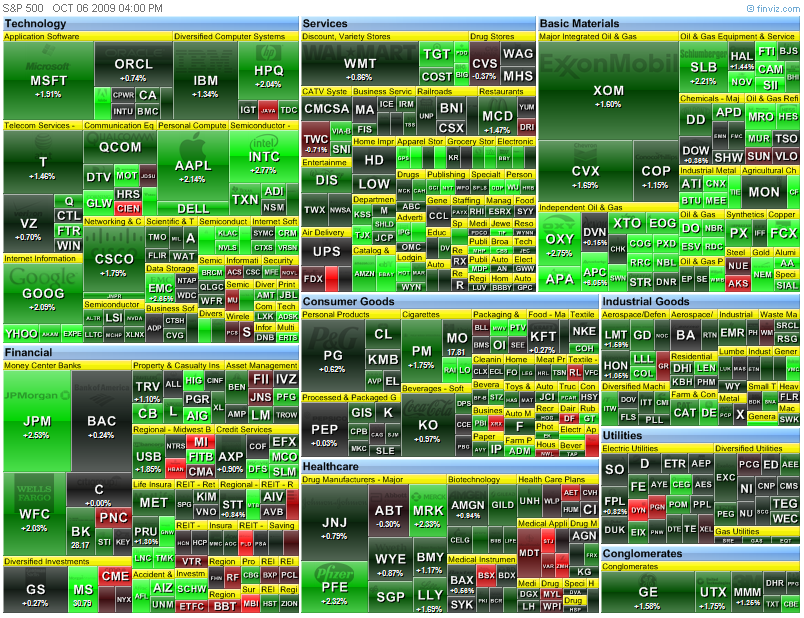
Today's heatmap:
Pre-market - Tuesday, October 6, 2009
Futures up pretty big this morning
DJIA INDEX 9,620.00 74.00
S&P 500 1,046.70 10.30
NASDAQ 100 1,688.00 14.00
Today's economic calendar:
ICSC-Goldman Store Sales 7:45 AM ET
Redbook 8:55 AM ET
4-Week Bill Auction 11:30 AM ET
3-Yr Note Auction 1:00 PM ET
Treasury STRIPS 3:00 PM ET
Today's earnings reports:
Before market opens:
CHTT Chattem Inc. Consumer Goods Personal Products
GIGM GigaMedia Ltd. Technology Internet Software & Services
PBG Pepsi Bottling Group Inc. Consumer Goods Beverages - Soft Drinks
After market closes:
ANGO AngioDynamics Inc. Healthcare Medical Instruments & Supplies
YUM Yum! Brands, Inc. Services Restaurants
Monday, October 5, 2009
Market wrap - 6:00
Dow 9,600 112 1.18%
Nasdaq 2,068 20 0.98%
S&P 500 1,040 15 1.49%
Gold 1,018 +14 +1.34%
Oil 70.25 0.46 0.66%
Today by sector:

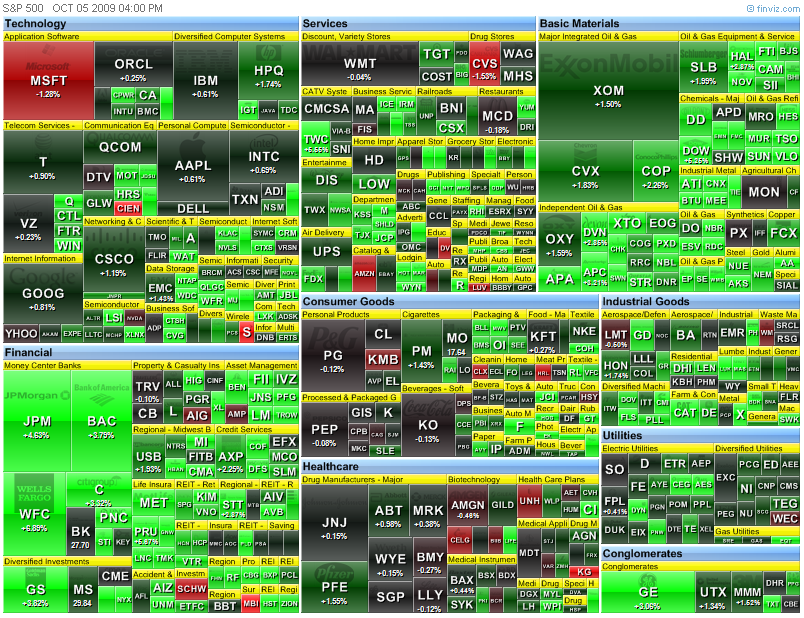
ISM non-mfg index report - 10:00
Full report here
September 2009 Non-Manufacturing ISM Report On Business®
NMI (Non-Manufacturing Index) at 50.9%
DO NOT CONFUSE THIS NATIONAL REPORT with the various regional purchasing reports released across the country. The national report's information reflects the entire United States, while the regional reports contain primarily regional data from their local vicinities. Also, the information in the regional reports is not used in calculating the results of the national report. The information compiled in this report is for the month of September 2009.
Business Activity Index at 55.1%
New Orders Index at 54.2%
Employment Index at 44.3%
More at link with formatted tables.
Pre-market - Monday, October 5,2009
Futures up this morning after a week won by the Bears:
DJIA INDEX 9,472.00 37.00
S&P 500 1,027.00 5.30
NASDAQ 100 1,672.00 9.75
Today's economic calendar:
ISM Non-Mfg Index 10:00 AM ET
4-Week Bill Announcement 11:00 AM ET
3-Month Bill Auction 11:30 AM ET
6-Month Bill Auction 11:30 AM ET
10-Yr TIPS Auction 1:00 PM ET
Today's earnings reports:
Before open:
RPM
After close:
MOS Mosaic Co. Basic Materials Agricultural Chemicals
PEDH Peoples Educational Holdings, Inc. Services Publishing - Books
RBN Robbins & Myers Inc. Industrial Goods Diversified Machinery
TISI Team Inc. Services Business Services
Friday, October 2, 2009
Op Ed piece from Meredith Whitney - 11:00
Link to WSJ article
The Credit Crunch Continues
Taxpayer dollars have supported institutions that are 'too big to fail.' Small business has been left out in the cold.
By MEREDITH WHITNEY
Anyone counting on a meaningful economic recovery will be greatly disappointed. How do I know? I follow credit, and credit is contracting. Access to credit is being denied at an accelerating pace. Large, well-capitalized companies have no problem finding credit. Small businesses, on the other hand, have never had a harder time getting a loan.
Since the onset of the credit crisis over two years ago, available credit to small businesses and consumers has contracted by trillions of dollars, and that phenomenon is reflected in dismal consumer spending trends. Equally worrisome are the trends in small-business credit, which has contracted at one of the fastest paces of any lending category. Small business loans are hard to find, and credit-card lines (a critical funding source to small businesses) have been cut by 25% since last year.
Unfortunately for small businesses, credit-line cuts are only about half way through. Home equity loans, also historically a key funding source for start-up small businesses, are not a source of liquidity anymore because more than 32% of U.S. homes are worth less than their mortgages.
Why do small businesses matter so much? In the U.S., small businesses employ 50% of the country's workforce and contribute 38% of GDP. Without access to credit, small businesses can't grow, can't hire, and too often end up going out of business. What's more, small businesses are often the primary source of this country's innovation. Apple, Dell, McDonald's, Starbucks were all started as small businesses.
What's especially disturbing is how taxpayer dollars have supported "too big to fail" businesses yet left small businesses unassisted and at a significant disadvantage. Small businesses do not have the same access to government guarantees on their debt. After all, most of these small businesses don't issue public debt.
As is true in most recessions, banks' commercial lending portfolios shrink as creditworthy customers pay down their debts and the less-worthy borrowers are simply denied loans. Banks, in other words, want to lend only to those that don't want to borrow. Challenging as that may be, in the last cycle small businesses at least had access to their credit cards.
Small businesses primarily fund themselves through credit cards and loans from local lenders. In the past two years, credit-card lines have been cut by over $1.25 trillion. During the same time, 10% of all credit-card accounts have been cancelled. According to the most recent Federal Reserve data, small business lending is down 3%, or $113 billion, from fourth-quarter 2008 peak levels—the first contraction since 1993. Credit cards are the most common source of liquidity to small businesses, used by 82% as a vital portion of their overall funding. Thus, it is of merit when 79% of small businesses surveyed tell the Small Business Association that credit-card lending standards have tightened drastically and their access to credit lines has decreased materially.
Incentives should be provided to smaller banks to step up small-business loans on a greater scale. Smaller banks could not only bridge gaps created by the shut down in the securitization market but also gaps being created by a massive contraction in credit-card lines. Arguably credit would perform better with these types of loans as they would reintroduce and reinforce the most important rule in banking: "Know Your Customer."
I believe that we are only in the early stages of the second half of this credit cycle. I expect another $1.5 trillion of credit-card lines to be removed from the system by the end of 2010. This includes not only the large lenders reducing exposure but also the shuttering of several major subprime credit-card lenders. Beginning in the fourth quarter of 2007, lenders began reducing available credit by zip code. During the past four quarters, lenders have cut "inactive" accounts (whether or not the customer viewed the account as a liquidity vehicle).
The next phase will likely be credit-line cuts as lenders race to pre-emptively protect themselves from regulatory changes associated with the Credit Card Accountability, Responsibility and Disclosure Act, passed in May of this year, and the 2008 Unfair and Deceptive Acts and Practices Act.
Regulators should be mindful that regulatory change during the midst of a credit crisis often ends with unintended consequences. Those same consumers that regulators are trying to help are actually being hurt by a vast reduction in available credit.
Main Street represents the foundation of this country. Reviving it should take priority over any regulatory reform or systemic overhaul.
Ms. Whitney is CEO of Meredith Whitney Advisory Group, LLC.
Factory orders - 10:00am
Full report here
August 2009 --------------- Released 10:00 A.M. EDT October 2, 2009
(M3-2(09)-08)
Note: All figures in text are in seasonally adjusted current dollars
For Data - (301) 763-4673
For Questions - Chris Savage or Jessica Young
(301) 763-4832
Summary
New orders for manufactured goods in August, down following four consecutive monthly increases, decreased $2.8 billion or 0.8 percent to $352.9 billion, the U.S. Census Bureau reported today. This followed a 1.4 percent July increase. Excluding transportation, new orders increased 0.4 percent. Shipments, down following two consecutive monthly increases, decreased $0.9 billion or 0.3 percent to $360.0 billion. This followed a 0.3 percent July increase. Unfilled orders, down eleven consecutive months, decreased $3.1 billion or 0.4 percent to $736.8 billion. This was the longest streak of consecutive monthly decreases since the series was first published on a NAICS basis in 1992. This followed a 0.1 percent July decrease. The unfilled orders-to-shipments ratio was 5.98, up from 5.94 in July. Inventories, down twelve consecutive months, decreased $3.9 billion or 0.8 percent to $498.2 billion. This was the longest streak of consecutive monthly decreases since February 2001-May 2002 and followed a 0.9 percent July decrease. The inventories-to-shipments ratio was 1.38, down from 1.39 in July.
New Orders
New orders for manufactured durable goods in August, down two of the last three months, decreased $4.4 billion or 2.6 percent to $164.1 billion, revised from the previously published 2.4 percent decrease. This followed a 4.8 percent July increase.
New orders for manufactured nondurable goods increased $1.5 billion or 0.8 percent to $188.7 billion.
Shipments
Shipments of manufactured durable goods in August, down following two consecutive monthly increases, decreased $2.4 billion or 1.4 percent to $171.3 billion, unchanged from the previously published decrease. This followed a 2.3 percent July increase.
Shipments of manufactured nondurable goods, up three of the last four months, increased $1.5 billion or 0.8 percent to $188.7 billion. This followed a 1.5 percent July decrease. This increase was due to petroleum and coal products, which increased $1.9 billion or 5.4 percent to $36.7 billion.
Unfilled Orders
Unfilled orders for manufactured durable goods in August, down eleven consecutive months, decreased $3.1 billion or 0.4 percent to $736.8 billion, unchanged from the previously published decrease. This was the longest streak of consecutive monthly decreases since the series was first published on a NAICS basis in 1992 and followed a 0.1 percent July decrease.
Inventories
Inventories of manufactured durable goods in August, down eight consecutive months, decreased $4.5 billion or 1.4 percent to $308.4 billion, revised from the previously published 1.3 percent decrease. This followed a 1.2 percent July decrease.
Inventories of manufactured nondurable goods, up following eleven consecutive monthly decreases, increased $0.6 billion or 0.3 percent to $189.9 billion. This followed a 0.4 percent July decrease. Petroleum and coal products drove the increase, up $0.7 billion or 2.8 percent to $27.4 billion.
By stage of fabrication, August materials and supplies decreased 0.8 percent in durable goods and 0.1 percent in nondurable goods. Work in process decreased 2.3 percent in durable goods and increased 1.4 percent in nondurable goods. Finished goods decreased 1.0 percent in durable goods and increased 0.1 percent in nondurable goods.
Employment report - 8:30am
Opps!
Full report here
THE EMPLOYMENT SITUATION -- SEPTEMBER 2009
Nonfarm payroll employment continued to decline in September (-263,000), and
the unemployment rate (9.8 percent) continued to trend up, the U.S. Bureau of
Labor Statistics reported today. The largest job losses were in construction,
manufacturing, retail trade, and government.
Household Survey Data
Since the start of the recession in December 2007, the number of unemployed
persons has increased by 7.6 million to 15.1 million, and the unemployment
rate has doubled to 9.8 percent. (See table A-1.)
Unemployment rates for the major worker groups--adult men (10.3 percent),
adult women (7.8 percent), teenagers (25.9 percent), whites (9.0 percent),
blacks (15.4 percent), and Hispanics (12.7 percent)--showed little change
in September. The unemployment rate for Asians was 7.4 percent, not season-
ally adjusted. The rates for all major worker groups are much higher than
at the start of the recession. (See tables A-1, A-2, and A-3.)
Among the unemployed, the number of job losers and persons who completed
temporary jobs rose by 603,000 to 10.4 million in September. The number of
long-term unemployed (those jobless for 27 weeks and over) rose by 450,000
to 5.4 million. In September, 35.6 percent of unemployed persons were job-
less for 27 weeks or more. (See tables A-8 and A-9.)
The civilian labor force participation rate declined by 0.3 percentage point
in September to 65.2 percent. The employment-population ratio, at 58.8 per-
cent, also declined over the month and has decreased by 3.9 percentage points
since the recession began in December 2007. (See table A-1.)
In September, the number of persons working part time for economic reasons
(sometimes referred to as involuntary part-time workers) was little changed
at 9.2 million. The number of such workers rose sharply throughout most of
the fall and winter but has been little changed since March. (See table A-5.)
About 2.2 million persons were marginally attached to the labor force in
September, an increase of 615,000 from a year earlier. (The data are not sea-
sonally adjusted.) These individuals were not in the labor force, wanted and
were available for work, and had looked for a job sometime in the prior 12
months. They were not counted as unemployed because they had not searched for
work in the 4 weeks preceding the survey. (See table A-13.)
Among the marginally attached, there were 706,000 discouraged workers in
September, up by 239,000 from a year earlier. (The data are not seasonally
adjusted.) Discouraged workers are persons not currently looking for work
because they believe no jobs are available for them. The other 1.5 million
persons marginally attached to the labor force in September had not searched
for work in the 4 weeks preceding the survey for reasons such as school
attendance or family responsibilities.
Establishment Survey Data
Total nonfarm payroll employment declined by 263,000 in September. From May
through September, job losses averaged 307,000 per month, compared with los-
ses averaging 645,000 per month from November 2008 to April. Since the start
of the recession in December 2007, payroll employment has fallen by 7.2 mil-
lion. (See table B-1.)
In September, construction employment declined by 64,000. Monthly job los-
ses averaged 66,000 from May through September, compared with an average of
117,000 per month from November to April. September job cuts were concen-
trated in the industry's nonresidential components (-39,000) and in heavy
construction (-12,000). Since December 2007, employment in construction has
fallen by 1.5 million.
Employment in manufacturing fell by 51,000 in September. Over the past 3
months, job losses have averaged 53,000 per month, compared with an average
monthly loss of 161,000 from October to June. Employment in manufacturing
has contracted by 2.1 million since the onset of the recession.
In the service-providing sector, the number of jobs in retail trade fell by
39,000 in September. From April through September, retail employment has
fallen by an average of 29,000 per month, compared with an average monthly
loss of 68,000 for the prior 6-month period.
Government employment was down by 53,000 in September, with the largest
decline occurring in the non-education component of local government
(-24,000).
Employment in health care continued to increase in September (19,000), with
the largest gain occurring in ambulatory health care services (15,000).
Health care has added 559,000 jobs since the beginning of the recession,
although the average monthly job gain thus far in 2009 (22,000) is down from
the average monthly gain during 2008 (30,000).
Employment in transportation and warehousing continued to trend down in
September. The number of jobs in financial activities, professional and
business services, leisure and hospitality, and information showed little
or no change over the month.
In September, the average workweek for production and nonsupervisory workers
on private nonfarm payrolls edged down by 0.1 hour to 33.0 hours. Both the
manufacturing workweek and factory overtime decreased by 0.1 hour over the
month, to 39.8 and 2.8 hours, respectively. (See table B-2.)
In September, average hourly earnings of production and nonsupervisory
workers on private nonfarm payrolls edged up by 1 cent, or 0.1 percent, to
$18.67. Over the past 12 months, average hourly earnings have risen by 2.5
percent, while average weekly earnings have risen by only 0.7 percent due
to declines in the average workweek. (See table B-3.)
The change in total nonfarm payroll employment for July was revised from
-276,000 to -304,000, and the change for August was revised from -216,000
to -201,000.
More at link with formatted tables
Pre-market - Friday, October 2, 2009
Futures down this morning waiting on the jobs report at 8:30
DJIA INDEX 9,439.00 -32.00
S&P 500 1,024.50 -2.90
NASDAQ 100 1,665.50 -5.00
Today's economic calendar:
Employment Situation 8:30 AM ET
Factory Orders 10:00 AM ET
Today's earnings reports:
NONE
Thursday, October 1, 2009
Market wrap - 4:30
Wow! Do I see Bears eating green shoots? They did today.
Dow 9,509 -203 -2.09%
Nasdaq 2,057 -65 -3.06%
S&P 500 1,030 -27 -2.58%
GlobalDow 1,855 -40 -2.09%
Gold 1,001 -9 -0.85%
Oil 70.32 0.21 0.30%
Today by sector:
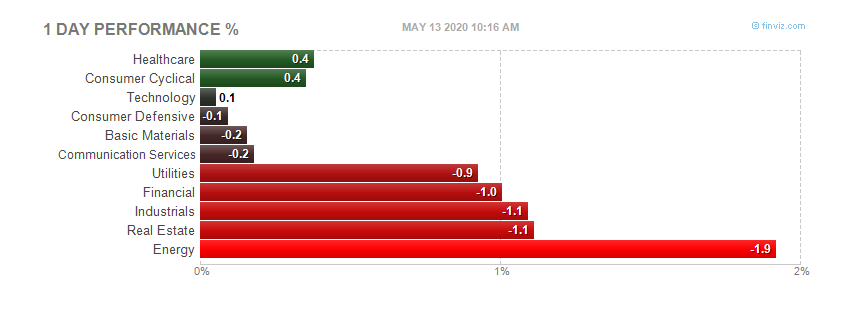 Today's heatmap:
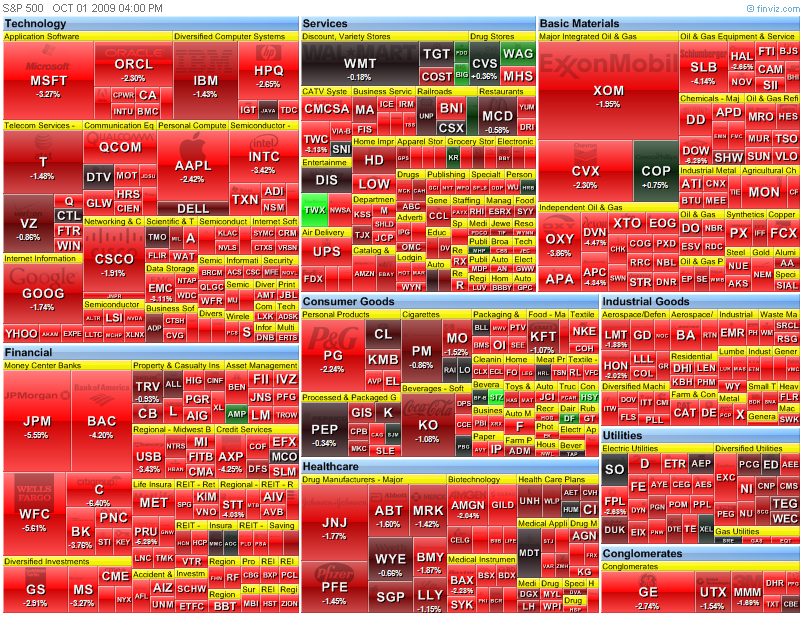
Today's heatmap:
New home sales index report - 10:00am
Full report here
Washington, October 01, 2009
Pending home sales have increased for seven straight months, the longest in the series of the index which began in 2001, according to the National Association of Realtors®.
The Pending Home Sales Index,* a forward-looking indicator based on contracts signed in August, rose 6.4 percent to 103.8 from a reading of 97.6 in July, and is 12.4 percent above August 2008 when it was 92.4. The index is at the highest level since March 2007 when it was 104.5.
Lawrence Yun, NAR chief economist, said not all contracts are turning into closed sales within an expected timeframe. “The rise in pending home sales shows buyers are returning to the market and signing contracts, but deals are not necessarily closing because of long delays related to short sales, and issues regarding complex new appraisal rules,” he said. “No doubt many first-time buyers are rushing to beat the deadline for the $8,000 tax credit, which expires at the end of next month.”
The Pending Home Sales Index in the Northeast jumped 8.2 percent to 85.3 in August and is 12.0 percent higher than August 2008. In the Midwest the index rose 3.1 percent to 90.8 in August and is 7.6 percent above a year ago. In the South, pending home sales increased 0.8 percent to an index of 104.6 and is 8.2 percent above August 2008. In the West the index surged 16.0 percent to 130.5 and is 22.3 percent above a year ago.
“There is likely to be some double counting over a span of several months because some buyers whose contracts were cancelled have found another home and signed a new contract to buy,” Yun explained. “Perhaps the real question is how many transactions are being delayed in the pipeline, and how many are being cancelled? Without historic precedents, it’s challenging to assess.”
Yun also noted that the data sample coverage for pending sales is smaller than the measurement for closed existing-home sales, so the two series will never match one for one.
NAR President Charles McMillan, a broker with Coldwell Banker Residential Brokerage in Dallas-Fort Worth, said first-time buyers need to act now. “Potential first-time buyers must make a contract offer very soon to have a reasonable chance of qualifying for the tax credit,” he said. “Congress needs to extend and expand this program because it’s stimulating the economy and reducing inventory close to price stabilization points.”
McMillan said a sizable number of homebuyers already in the pipeline could be let down because of the tight deadline. “We know there is a pent-up demand because sales are below normal levels for the size of our population. The faster we absorb excess inventory, the sooner we’ll turn the corner on home prices, prevent additional families from becoming upside-down in their mortgages, and give Wall Street the confidence to extend credit to other sectors,” he said. “Each home sale pumps an additional $63,000 into the economy through related goods and services, so the benefits of extending and expanding the tax credit far outweigh the costs.”
Yun said the forecast for home sales and prices depends very much on whether a tax credit is extended. “All we can say for certain is sales will decline when the tax credit expires because we are not yet on a self-sustaining recovery path. It also raises a risk of a double-dip recession,” he said. “Extending and expanding the tax credit is the best tool in our arsenal to encourage financially qualified buyers to stimulate the economy and help reduce the budget deficit.”
The National Association of Realtors®, “The Voice for Real Estate,” is America’s largest trade association, representing 1.2 million members involved in all aspects of the residential and commercial real estate industries.
Construction spending - 10:00am
Full report here
AUGUST 2009 CONSTRUCTION AT $941.9 BILLION ANNUAL RATE
The U.S. Census Bureau of the Department of Commerce announced today that construction spending during August 2009 was estimated at a seasonally adjusted annual rate of $941.9 billion, 0.8 percent (±1.8%)* above the revised July
estimate of $934.6 billion. The August figure is 11.6 percent (±1.8%) below the August 2008 estimate of $1,066.1 billion. During the first 8 months of this year, construction spending amounted to $629.5 billion, 11.9 percent (±1.3%) below the $714.3 billion for the same period in 2008.
PRIVATE CONSTRUCTION
Spending on private construction was at a seasonally adjusted annual rate of $622.1 billion, 1.8 percent (±1.1%) above the revised July estimate of $611.1 billion. Residential construction was at a seasonally adjusted annual rate of $249.5 billion
in August, 4.7 percent (±1.3%) above the revised July estimate of $238.3 billion. Nonresidential construction was at a seasonally adjusted annual rate of $372.6 billion in August, 0.1 percent (±1.1%)* below the revised July estimate of $372.8 billion.
PUBLIC CONSTRUCTION
In August, the estimated seasonally adjusted annual rate of public construction spending was $319.8 billion, 1.1 percent (±2.7%)* below the revised July estimate of $323.5 billion. Educational construction was at a seasonally adjusted annual
rate of $89.2 billion, nearly the same as (±4.2%)* the revised July estimate of $89.3 billion. Highway construction was at a seasonally adjusted annual rate of $85.2 billion, 0.8 percent (±7.5%)* above the revised July estimate of $84.5 billion.
More at link.
ISM report - 10:00am
Full report here
September 2009 Manufacturing ISM Report On Business®
PMI at 52.6%
DO NOT CONFUSE THIS NATIONAL REPORT with the various regional purchasing reports released across the country. The national report's information reflects the entire United States, while the regional reports contain primarily regional data from their local vicinities. Also, the information in the regional reports is not used in calculating the results of the national report. The information compiled in this report is for the month of September 2009.
New Orders and Production Growing
Employment and Inventories Contracting
Supplier Deliveries Slower
(Tempe, Arizona) — Economic activity in the manufacturing sector expanded in September for the second consecutive month, and the overall economy grew for the fifth consecutive month, say the nation's supply executives in the latest Manufacturing ISM Report On Business®.
The report was issued today by Norbert J. Ore, CPSM, C.P.M., chair of the Institute for Supply Management™ Manufacturing Business Survey Committee. "The manufacturing sector grew for the second consecutive month in September. While the rate of growth moderated slightly when compared to August, the recovery broadened as the number of industries reporting growth increased from 11 to 13. Both new orders and production are growing, but at a slower rate when compared to August. It appears the fundamentals for continuing recovery are still at work as inventories and sales are gaining balance. This month, we asked a special question with regard to the American Recovery and Reinvestment Act. Twelve of the 18 manufacturing industries expect to derive some benefit from the program, and 12 manufacturing industries responded that they expect their companies to see some benefit."
PERFORMANCE BY INDUSTRY
In September, 13 of the 18 manufacturing industries reported growth. The industries — listed in order — are: Wood Products; Paper Products; Apparel, Leather & Allied Products; Transportation Equipment; Textile Mills; Printing & Related Support Activities; Petroleum & Coal Products; Electrical Equipment, Appliances & Components; Fabricated Metal Products; Chemical Products; Computer & Electronic Products; Miscellaneous Manufacturing; and Food, Beverage & Tobacco Products. The four industries reporting contraction in September are: Primary Metals; Furniture & Related Products; Plastics & Rubber Products; and Machinery.
WHAT RESPONDENTS ARE SAYING ...
* "Purchasing remains a challenge as suppliers now seem to be trying to raise pricing at any sign of life in the economy." (Computer & Electronic Products)
* "Business is picking up — lots of opportunities." (Primary Metals)
* "Agricultural commodities continue to weaken, with the exception of the domestic and world sugar markets." (Food, Beverage & Tobacco Products)
* "Automotive demand continues to be strong even after 'cash for clunkers.'" (Fabricated Metal Products)
* "Business remains slow, with no sign of improvement again this month." (Nonmetallic Mineral Products)
More at link
Jobless claims - 8:30am
Opps! But good news, not as bad as expected. CNBC giddy over the numbers.
Full report here
UNEMPLOYMENT INSURANCE WEEKLY CLAIMS REPORT
SEASONALLY ADJUSTED DATA
In the week ending Sept. 26, the advance figure for seasonally adjusted initial claims was 551,000, an increase of 17,000 from the previous week's revised figure of 534,000. The 4-week moving average was 548,000, a decrease of 6,250 from the previous week's revised average of 554,250.
The advance seasonally adjusted insured unemployment rate was 4.6 percent for the week ending Sept. 19, unchanged from the prior week's unrevised rate of 4.6 percent.
The advance number for seasonally adjusted insured unemployment during the week ending Sept. 19 was 6,090,000, a decrease of 70,000 from the preceding week's revised level of 6,160,000. The 4-week moving average was 6,154,500, a decrease of 39,250 from the preceding week's revised average of 6,193,750.
The fiscal year-to-date average for seasonally adjusted insured unemployment for all programs is 5.665 million.
UNADJUSTED DATA
The advance number of actual initial claims under state programs, unadjusted, totaled 443,694 in the week ending Sept. 26, an increase of 5,878 from the previous week. There were 392,515 initial claims in the comparable week in 2008.
The advance unadjusted insured unemployment rate was 3.8 percent during the week ending Sept. 19, a decrease of 0.1 percentage point from the prior week. The advance unadjusted number for persons claiming UI benefits in state programs totaled 5,054,617, a decrease of 169,287 from the preceding week. A year earlier, the rate was 2.3 percent and the volume was 3,018,976.
Extended benefits were available in Alabama, Alaska, Arizona, Arkansas, California, Colorado, Connecticut, Delaware, the District of Columbia, Florida, Georgia, Idaho, Illinois, Indiana, Kansas, Kentucky, Maine, Massachusetts, Michigan, Minnesota, Missouri, Nevada, New Hampshire, New Jersey, New Mexico, New York, North Carolina, Ohio, Oregon, Pennsylvania, Puerto Rico, Rhode Island, South Carolina, Tennessee, Texas, Vermont, Virginia, Washington, West Virginia, and Wisconsin during the week ending Sept. 12.
Initial claims for UI benefits by former Federal civilian employees totaled 1,455 in the week ending Sept. 19, an increase of 323 from the prior week. There were 2,296 initial claims by newly discharged veterans, an increase of 367 from the preceding week.
There were 20,408 former Federal civilian employees claiming UI benefits for the week ending Sept. 12, an increase of 1,202 from the previous week. Newly discharged veterans claiming benefits totaled 30,689, an increase of 457 from the prior week.
States reported 3,275,213 persons claiming EUC (Emergency Unemployment Compensation) benefits for the week ending Sept. 12, an increase of 99,832 from the prior week. There were 1,559,198 claimants in the comparable week in 2008. EUC weekly claims include both first and second tier activity.
The highest insured unemployment rates in the week ending Sept. 12 were in Puerto Rico (6.1 percent), Oregon (5.4), Nevada (5.3), Pennsylvania (5.3), California (4.9), Michigan (4.9), Wisconsin (4.8), New Jersey (4.7), North Carolina (4.7), Arkansas (4.6), and South Carolina (4.6).
The largest increases in initial claims for the week ending Sept. 19 were in California (+5,112), Texas (+3,946), Florida (+2,348), Iowa (+2,013), and Illinois (+1,945), while the largest decreases were in Kansas (-1,545), Wisconsin (-1,258), Oregon (-833), Ohio (-804), and New York (-623).
More at link with formatted tables
Futures down this morning waiting on economic data.
DJIA INDEX 9,609.00 -44.00
S&P 500 1,046.50 -6.40
NASDAQ 100 1,706.75 -10.75
Today's economic reports:
Monster Employment Index
Motor Vehicle Sales
Challenger Job-Cut Report 7:30 AM ET
Personal Income and Outlays 8:30 AM ET
Jobless Claims 8:30 AM ET
Ben Bernanke Speaks 9:00 AM ET
30-Yr Bond Announcement 9:00 AM ET
ISM Mfg Index 10:00 AM ET
Construction Spending 10:00 AM ET
Pending Home Sales Index 10:00 AM ET
EIA Natural Gas Report 10:30 AM ET
3-Month Bill Announcement 11:00 AM ET
6-Month Bill Announcement 11:00 AM ET
3-Yr Note Announcement 11:00 AM ET
10-Yr Note Announcement 11:00 AM ET
10-Yr TIPS Announcement 11:00 AM ET
Today's earnings reports:
Before open:
CRAI CRA International Inc. Services Management Services
MTRX Matrix Service Co. Industrial Goods Heavy Construction
STZ Constellation Brands Inc. Consumer Goods Beverages - Wineries & Distillers
After close:
ACN Accenture plc Services Management Services
BLUD Immucor Inc. Healthcare Diagnostic Substances
CREL Corel Corporation Technology Multimedia & Graphics Software
DMAN DemandTec, Inc. Technology Business Software & Services
GPN Global Payments Inc. Services Business Services
RECN Resources Connection Inc. Services Management Services
SMOD SMART Modular Technologies (WWH) Inc. Technology Semiconductor - Integrated Circuits
SMSC Standard Microsystems Corp. Technology Semiconductor - Integrated Circuits
TSCM TheStreet.com, Inc. Technology Internet Information Providers
Subscribe to:
Posts (Atom)
